Travel, Eat, Discover: South Africa
South Africa, Part I: Cape Town Through an Ancestral Lens (Days 1–5)
Time on earth is limited. And while aging with grace is nice, I personally prefer aging with mischief, audacity, and a really good story to tell.
This trip to South Africa was exactly that.
I wanted to write this so you truly understand how I prepare for travel, how I eat well while abroad, and how I consistently find places that align with a healthy, grounded lifestyle—far beyond tourist checklists. These first five days were spent in Cape Town and Stellenbosch, and they set the tone for everything that followed.
Preparing for Travel: Real Food, Flexibility, and Trust
Normally, I travel with a full food-prep strategy: cooked meals, containers, and sometimes even frozen meat packed in a checked bag depending on the destination. I usually stay in Airbnbs where I know I’ll be cooking most days.
This trip was different.
I knew I’d be moving constantly and outsourcing more of my food than usual—something I’m not always comfortable with. I typically rely on local farms or farmers markets so I can cook for myself, but that wasn’t realistic this time. That meant navigating seed oils, hidden ingredients, and food choices that don’t always align perfectly when someone else is cooking for you—while still wanting to embrace the local food culture and explore.
That said, this wasn’t a destination filled with fast-food chains and ultra-processed junk. With research and preparation, I trusted I’d land somewhere rich in real food culture. Sometimes you have to loosen the grip just enough and let the experience meet you halfway.
Before I dive into how I navigated food once I arrived, let’s talk flight food.
What I Packed for Basically a 24-Hour Travel Day
This included one 14-hour flight plus connections, customs, and arrival.
Here’s what came with me on the plane:
Canned fish
20 UMF Manuka honey (energy + antibacterial support—especially helpful while traveling or in the wild. Shop with code: BAE )
Organic freeze-dried coffee packets
Travel-size salt (shop with code: BAE15)
Carnivore Bars (shop with code: BAE10)
Frozen bone broth through TSA and then melted in flight!
A frozen raw milk protein shake I pre-made using the Organised Protein Blend (shop with code: BAE10)
Kalahari Biltong (ya know, to set the tone)
A heated travel mug (honest review: not my favorite—it took nearly two hours to warm and never got truly hot; still searching for a better in-flight option)
Between TSA, customs, and long hours in the air, everything thawed naturally in time to eat. I still had sealed canned fish, honey, and bars left once I landed—no issues going through customs, though this can vary by destination and even by the day. Having these on standby was clutch; they came in handy more than once. If I hadn’t brought them, I would’ve immediately sourced similar staples from a local shop to keep on hand—which ended up being necessary later in the trip anyway.
Non-Food Travel Essentials That Made a Difference
Beyond food, I set myself up for success with a few intentional extras:
Red lenses/ blue-light blocking glasses to reduce junk light and support sleep (highly recommend flying and traveling with these to maintain a consistent rhythm. Shop with code: BAE15)
Be Here Farm Hydrating Mist — a high-quality botanical mist that felt incredible on a long-haul flight
Super-comfy natural-fiber bamboo joggers and an oversized hoodie by Allwear (shop with code: BAE20)
Compression socks
LEMS footwear — wide toe box, barefoot-style comfort so my body didn’t feel crushed after long travel days. They are also the best travel shoes ever (shop with code: BAE10)
A couple of small red-light motion-sensors for hotel rooms and evenings (easy to toss in a bag. shop with code: BAE15)
I didn’t take any vaccines or malaria prescriptions (not required for this trip), but I did bring an emergency kit from The Wellness Company—just in case. (shop with code: BAE)
Jet lag tip: If you land during the day, get sunlight on your face and feet on the ground immediately. Circadian rhythm matters more than most people realize. I skipped this on arrival (rookie mistake) and felt it that night and the next. The following day, I made it a priority to get sun—and it made a noticeable difference.
Community Is Everything: Finding the Real Gems
Before this trip, I connected with Reeco from Ancestral Nourishment. We’d been following each other on Instagram for a while, so I reached out for recommendations—and this is where the magic usually starts. The best experiences don’t come from Google; they come from community.
Reeco shared incredible places to visit, eat, and connect, and from there everything began to unfold naturally. His recommendations—and the people he introduced me to—led me to nearly all the gems I found on this leg of the trip. Because they share the same values and mindset we do, trusting the process felt easy. I didn’t have to do heavy research or second-guess every decision.
I also asked him directly about safaris—where to go, what to avoid, and how to navigate them responsibly. I’m naturally cautious about safety and deeply mindful of the intentions behind wildlife tourism, so it mattered to me that any safari experience truly respected the land and animals. Knowing the money was going toward ethical operations focused on conservation—not exploitation—calmed my nerves and made it easier to say yes to adventure. That guidance alone was invaluable, and I can’t thank him enough for helping me experience this place in a way that felt aligned, respectful, and meaningful.
Cape Town Arrival & First Meal
I landed around 4:30 pm and made the mistake of not getting outside before dark—sleep wasn’t great that first night. But I did eat well.
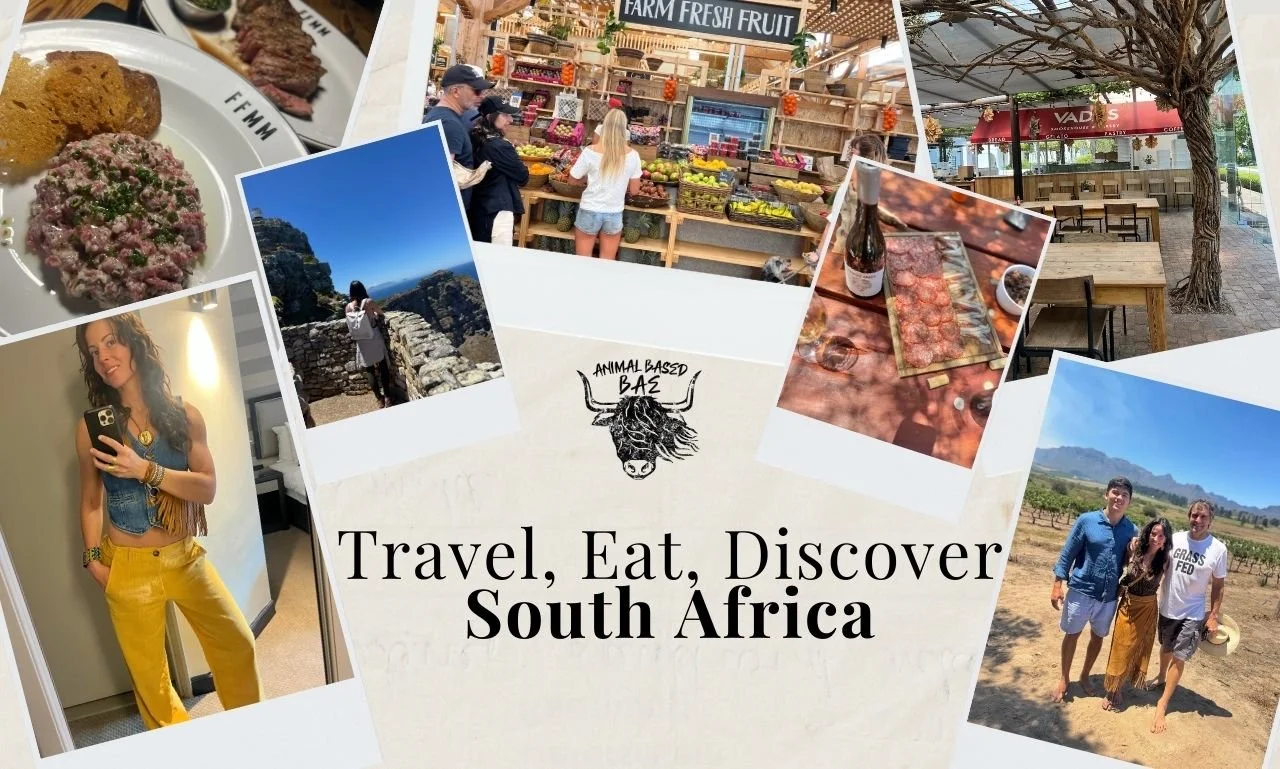
My first dinner was at Frankie Fenner Meat Merchants, and it immediately set the tone. Recently opened, deeply focused on sourcing, and run by people who clearly care. Incredible biltong (I’m officially converted), house-made tallow for cooking (and skincare), fresh eggs, and a butcher counter if you’re staying somewhere you can cook.
Some dishes still may use seed oils, but the owner and I had a long conversations and he is completely aware and actively working on improving making this swap—always a green flag. They’re meat sourcing is absolute top notch and their dishes are incredible! You can easily order grilled meats without them for now. These are our people.
I ordered the steak tartare and a perfectly grilled steak with chimichurri—simple, bold, and done right. It was AMAZING!
Hotel Life, Movement & Simple Meals
My hotel (near the waterfront) had a gym and sauna—something I didn’t specifically seek out, but appreciated having. With a lingering back injury, I focused on stretching, light movement, and a few sauna sessions. Mostly, though, I enjoyed slow mornings and laying by the pool during downtime. I really needed that.
Breakfast was included. Nothing spectacular, but workable: hard-boiled eggs, fresh fruit, and occasionally a few slices of cheese. That was enough for me. Of course, I had the coffee.
Water: I usually go out of my way to find glass bottles, and while I did that at times, I wasn’t overly strict on this trip. Yes—I drank from plastic bottles (gasp). I honestly don’t know why I didn’t make it a bigger priority, except that I think I had already accepted I’d be outsourcing more this trip and working with what was available. I just wasn’t in my usual hyper-intentional mode.
I’m generally very mindful about avoiding microplastics because it’s something I care deeply about, so I felt confident I’d be okay. Side note: I’ll be doing a full plastic detox when I get back. Stay tuned for that protocol!
Markets, Butchers & Everyday Nourishment
Back in Cape Town, I spent time at Oranjezicht City Farm Market, one of the best farmers markets I’ve ever been to. Local food, artisans, great coffee, handmade goods—and yes, biltong. It’s not just a market; it’s a destination.
Another excellent stop was L.A. Farms—a more robust grocery experience with incredible meats, a full butcher counter, and even a sit-down meal option. Everything felt high-quality and thoughtfully sourced—exactly our kind of place. I found some great specialty items here, including raw milk and kefir (which I immediately snagged), and this is also where I stocked up on glass bottles. I also ordered the filet for a sit-down meal!
And yes—I went back to Frankie Fenner Meat Merchants again once my friend landed. It was that good and had to share the experience!
Places recommended by the community that I didn’t get to this time (but are firmly on the list for next time):
Loading Bay
Pauline’s (Green Point)
Belly of the Beast
Sans Community
Stellenbosch, Spier Vineyards & a True Braai
Reeco also pointed me toward standout farmer Angus, a passionate advocate for regenerative agriculture near Stellenbosch. What followed was one of the most meaningful and grounding food experiences I’ve had in a long time.
I met Reeco in Stellenbosch, where he greeted me with venison supplements and tallow balm—a thoughtful reminder that nourishment can (and should) travel with you. A lot of his sourcing comes directly from Farmer Angus’ farms, and seeing that level of integrity and quality in action was incredibly refreshing. It’s rare—and beautiful—to witness farmers this deeply committed to regenerative living, eating, and farming.
We toured the farm with a group of friends, along with some new, passionate friends who share our love for food and culture, which made the experience even more special. Beyond the sheer beauty of the land, it was an education in how intentional farming changes everything—from soil health to animal vitality to the nutritional density of the food we eat. Angus runs a true multi-species operation: Angus cattle, pigs, chickens, and other animals all working together within a living ecosystem. Everything is pasture-raised, the land looked vibrant and alive, and the animals reflected that health. We even stumbled upon pigs who had just had babies—an unexpected and adorable highlight.
After the farm tour, we enjoyed a picnic overlooking Spier Wine Farm, another part of Angus’ operation. Sitting on the vineyard, eating pasture-raised meats, drinking organic wine, and actually seeing where everything comes from—it truly changes you.
At one point, Angus casually said, “Most wines are basically feedlot wine.”
Instant lightbulb moment. I hadn’t fully realized how similar conventional wine production is to industrial food systems.
I don’t drink much, and when I do, I’m selective. I’ve tried organic wines before and was never particularly impressed—but this was different. Clean. Balanced. Alive. And actually delicious. It completely reshaped how I think about sourcing wine going forward. Like coffee, I don’t want something watered down or flavorless—I want depth, integrity, and a robust experience. This delivered all of it.
From there, we ventured deeper into Spier Wine Farm itself—a place where you can stay, eat, and fully immerse yourself in the land. The property is peaceful, intentional, and thoughtfully designed. You genuinely don’t have to worry about being “poisoned on vacation” here, which felt like a luxury in itself.
We were met by the chef from Vadas Smokehouse, a restaurant on the property, who prepared one of the best meals I’ve had in quite some time. Reeco, Angus, and the rest of our group sat down for joyful, meaningful conversations about food, wine, land, and being human. I had mentioned wanting to experience a traditional South African braai, and that’s exactly what we got—bone marrow, beef cheeks, sausages, and liver cooked over open fire. Every bite was intentional, nourishing, and worry-free from an ingredient standpoint.
When asked ‘Howzit?’—typical South African lingo—not only did my eyes and face soften with pure culinary delight and quality, but the experience was grounding, generous, and unforgettable.
You can order some of their wines globally, and if you ever visit South Africa, a day in Stellenbosch—especially at Spier—is absolutely non-negotiable.
Before heading back to Cape Town, Farmer Angus recommended one final stop: Rust en Vrede Wine Estate. We popped in on our way out, and it was yet another standout—an excellent note to end an extraordinary day.
Spontaneous Days & Unexpected Adventures
Even with a few planned excursions, I loved keeping parts of my days open and spontaneous. I wandered through local shops and stumbled upon a gem—a beautiful eco-friendly home goods store carrying Spaza dish covers, which I already use and love at home. They’re sold in the States, so discovering their origin story in Cape Town felt incredibly full-circle. I also picked up their natural fiber face pads—perfect for removing makeup and cleansing the skin. They’re washable, travel-friendly, and just as ideal for everyday use at home. Their products are well-crafted, functional, and genuinely beautiful—everyday essentials with heart and intention. Naturally, I had to snag a few.
I also found a stunning local artist shop and picked up some original photography pieces. Between those finds, I explored neighborhoods on foot and soaked up Cape Town’s energy at my own pace.
I even did the unexpected and hopped on a very touristy peninsula tour—something I normally avoid—but it felt right being in the flow of this trip. While I probably wouldn’t do it exactly the same way again, I loved seeing the dramatic coastline, learning about the quaint towns along the route, taking a boat out to Seal Island, and spotting African pelicans—which completely threw me for a loop in the best way. It was unexpectedly fun and a reminder that releasing expectations often leads to the most memorable moments.
Some of my favorite days were the quieter ones—catching up with friends, having long, meaningful conversations, and spending in-between days with my best friend by the pool, soaking up the sun and sharing laughs. Those moments were just as nourishing as the big adventures.
Pro tip: The sun is stronger there, and although I rarely wear sunscreen, I found I needed a little extra protection. I stuck with a non-toxic option—Motherfo Care Suncream—and it did the job without compromising my standards. ☀️
Traveling Well While Moving Constantly
As I prepared to leave Cape Town—my heart full, still buzzing from the experiences, the food, and the incredible community—I began the next phase of the journey: heading deeper into the wild safari regions. Before departing, I stocked up on biltong from the butcher shops I’d discovered, and also brought along tallow balms, soaps, and organ supplements generously gifted by my new friends. These small comforts and essentials felt like little anchors as I ventured into places where predictability was limited.
I’ll admit, I was a bit nervous. When filling out the safari intake forms, I basically listed every restriction imaginable—gluten-free, nut-free, seed-oil-free, no grains—and then added a final note: just meat, dairy, and fruit, no oils, please. I could only hope the message was received. It felt a little like sending out a flare into the unknown, trusting that the experience would meet me halfway.
Keeping food and essentials on hand isn’t about rigidity—it’s about freedom. It allows me to be fully present, to embrace the adventure without letting basic nourishment become a source of stress. That balance—prepared but open, intentional yet flexible—is exactly how I approach travel. It gives me space to lean into the new experiences, the unexpected encounters, and the lessons only the road (and the wild) can teach.
Next: Into the Wild
These first five days were just the beginning. From Cape Town, I traveled onward to Kruger National Park, where the pace slowed, the land spoke louder, and the safari experience reshaped me in ways I’m still unpacking.
There were surprises—like being thrown off a horse when something darted out of the bushes—and lessons in letting go, including navigating food that wasn’t great at first and figuring out how to make it work anyway.
As I mentioned at the start of this journey, time on earth is limited. While I cherish grounding experiences and staying consistent with health and diet, I also crave mischief, audacity, and stories worth telling. This next leg promised exactly that—and then some.
That story deserves its own chapter.
Coming next: South Africa, Part II — Kruger National Park, Safari Life, Botswana, a horseback encounter I won’t forget, and what nature teaches you when you finally listen.