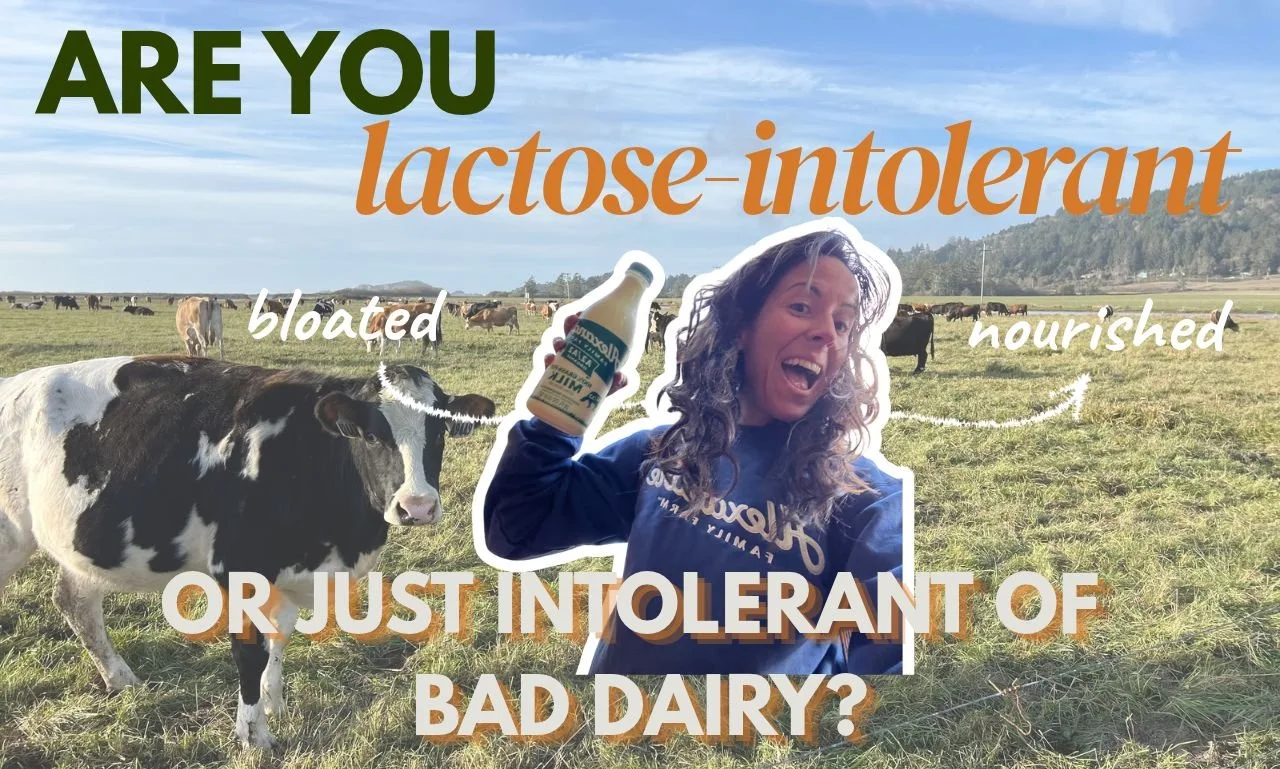
Are You Lactose Intolerant, or Just Intolerant of Bad Dairy?
You got bloated after a latte, a slice of cheese, or a baked good with dairy in it. Someone said, "You must be lactose intolerant." And just like that, you quit dairy, sometimes for years, without ever testing it.
Here's the question nobody asked you: was it dairy, or was it bad dairy?
I don't mean spoiled milk, the kind that smells or tastes off. I mean the hidden differences you can't taste: the breed of the cow, her genetics, how she lives, what she eats, and how the milk is handled. All of that can vary from one carton to the next. So before you write off an entire food group, it's worth asking what was actually in your cup.
I apply this thinking to everything. Take eggs: what the hens eat has a strong link to how your body responds to them. Or meat:
Is it gamey, or did you buy it from the wrong place, where the quality was poor?
Is it tough, or do you just not know how to cook it?
Is it the food, or is it the variables that produced it?
More often than we think, it's the variables. This is the lens I use for an animal-based way of eating: before I blame the food, I ask where it came from and how it was raised.
The hidden cost of the "allergy diet"
Cutting dairy sounds simple until you live it. You read every label. You dodge restaurants. You decline holiday dishes and field the awkward questions at the table. Food starts to feel like a threat, and that mental load is real.
Then there are the substitutes. Many oat, almond, and soy milks come with gums, seed oils, and added sugar. Those inflammatory oils are not doing us any favors for our biomarkers and our weight management. Meanwhile, you give up easily absorbed protein, fat-soluble vitamins, and the joy of cooking with butter and cream, the foods people have cooked with for centuries.
On an animal-based diet, dairy sits alongside meat, eggs, fruit, and honey as simple, nutrient-dense foods, and the shorter the ingredient list, the better.
Intolerance vs. allergy: two different things
Before you decide which one you have, it helps to know they are separate problems. This post is mostly about digestibility, but the allergy question belongs here too.
Lactose intolerance is a digestion issue. Your body doesn't make enough lactase, the enzyme that breaks down lactose, the sugar in milk. Typical symptoms are bloating, gas, cramping, and loose stools.
Milk allergy is an immune reaction to milk proteins (casein or whey). It can show up as hives, swelling, wheezing, vomiting, or, in serious cases, anaphylaxis.
The gray area in between. Plenty of people feel off after dairy and never get tested for either one. They simply assume. A doctor can tell you which, if either, applies to you, and a lactose breath test is one way to check.
If you have a diagnosed milk allergy, this post is not a green light. Still, the kind of dairy and the type of animal it comes from are questions worth exploring. And if you've only ever assumed you're lactose intolerant, keep reading, because there's more to look at before you settle on that answer.
What "bad dairy" might actually mean
I'm not here to call every grocery-store carton poison, though I'll be honest: there are only a brand or two I'd buy from a typical, nationwide grocery store (more on that below). "Bad dairy" can mean a few different things:
The wrong protein for your body. This is arguably the main culprit. It comes down to the breed of the cow and her genetics: A1/A1, A1/A2, or A2/A2, plus which animal the milk comes from. More on that next.
Milk from stressed, unhealthy cows. Animal health and low-stress living may matter more than most of us were taught. On every farm I’ve visited, across dairy, meat, and eggs, I’ve seen the same pattern: animals kept away from pasture, sun, and the chance to express natural behavior tend to produce food with lower nutritional value. Stress also shows up hormonally, with cortisol, the stress hormone, being the best known. All of these factors influence what's in the milk to begin with, from its nutritional composition to the way your body may digest and respond to it.
Highly processed products. Processed doesn't automatically mean bad, but heavy processing can strip out the live bacteria and enzymes that may help with digestion and nutrient absorption. Many conventional brands are ultra-pasteurized (UHT) for shelf life, and flavored products like chocolate milk, seasonal eggnog, and yogurts often add thickeners, stabilizers, or sugar on top.
Why A2/A2 might be the missing piece
Cow's milk contains a protein called beta-casein, which comes in different versions. The two most common are A1 and A2. They differ by a single amino acid, but that small change affects how the protein is broken down during digestion. When A1 is digested, it can release a small peptide called BCM-7, which researchers are still studying for a possible link to digestive discomfort. The evidence isn't settled, so I'll call this "worth exploring," not "proven." However, so many people report fewer digestive problems with milk from cows that carry only the A2 version (A2/A2).
There may also be differences in how these proteins interact with other components of milk and form casein structures, although the significance of those differences for human digestion is still being studied. And, of course, beta-casein is only one part of the picture. Lactose, fat composition, other milk proteins, and processing can all influence how someone responds to dairy.
The honest caveat: A2 milk still contains lactose. It won't fix true lactose intolerance, and it isn't for milk allergy. But if you suspect it's the protein and not the sugar, it's a simple experiment. Plenty of people label themselves lactose intolerant without ever testing the A1 question.
How did cows go from A2 to A1?
A2 is the original: all cattle once made A2 beta-casein, like most mammals, humans included. Somewhere between 5,000 and 10,000 years ago, a natural mutation appeared in European cattle and created A1.
Nobody engineered it, and nobody picked A1 on purpose. It spread because it traveled with high-yield breeds. In the 20th century, Holstein Friesians, bred for sheer volume of milk, took over dairies worldwide, and A1 came along for the ride. More milk per cow lowers the cost per gallon, so economics did drive the shift, but the protein was a side effect. Traditional breeds like Guernsey and Jersey, and cattle in much of Asia and Africa, kept far more A2.
That's why I think A2/A2 is also a great filter for farming practices. Farms that stick with A2 are usually thinking about quality, digestibility, and health, not just pumping out volume. That's my opinion, and it probably isn't true of every farm, but it's the lens I use.
Why goat milk helps some people
This is why so many people say switching to goat milk helped them. Goat milk naturally contains A2-type beta-casein rather than A1, which may be one reason some people find it easier to digest. Camel milk is also commonly described as A2-type, as are sheep and water buffalo milk. Human breast milk contains a different type of beta-casein, but is generally considered A2-like.
And this brings up another important point: milk reflects more than just the animal producing it. Think about breast milk. A mother's diet can influence the composition of her milk, and in some cases, babies may react to certain food proteins that pass through it. The same broader principle applies to dairy animals: what they're eating, how they're raised, and the environment they live in all contribute to the milk they produce. If we want to understand the quality of the milk we're consuming, we have to look beyond the milk itself and consider what went into producing it.
I go deeper on all the animal milks in another post: Why Quality Dairy Matters.
I had to see it for myself
A2/A2 is only half the story. It tells you something about the protein in the milk, but not the whole story of how that milk was produced. The milk starts with the cow, and the cow's health starts with how she's raised, what she's fed, and the environment she lives in.
I believe those factors matter just as much when we're talking about how our bodies respond to dairy. Genetics and protein type are one piece of the puzzle, but animal health, diet, living conditions, and how the milk is handled all deserve a closer look.
Many of you know I love visiting the farms I buy from, meat and dairy alike. Seeing an A2/A2 label is a good starting point, but it's not enough for me. I want to know how the animals are actually raised and see the operation with my own eyes. Usually, that means small local farms or family farms that ship regionally or nationwide directly to consumers.
This time, I did something I've never done before: I visited Alexandre Family Farm, a well-known dairy brand you can find in grocery stores.
I'd been buying their milk for several reasons, including their commitment to A2/A2 dairy and a strong recommendation from Will Harris of White Oak Pastures, a farm I completely respect and have visited many times. But I'd also been hearing things online that seemed out of character, and I wanted to find out for myself whether there was any truth to them.
Farming gets attacked a lot, and small farms often take the hardest hits. Some criticism comes from people with an agenda, whether animal activists or those who believe cattle are inherently harmful to the environment. Small raw milk dairies have also faced raids and regulatory hurdles that can come with significant costs and make it harder to keep their doors open. I believe big agribusiness has little incentive to see independent farmers thrive. I have plenty more to say about that in other posts, so I won't get off topic here.
The farms I choose to support are about as far from the industrial farming model as you can get. But I don't want to make assumptions based on a label, a brand, or someone else's opinion. I wanted to see how Alexandre operated for myself, and I was welcomed with open arms.
Enter Alexandre Family Farm
Alexandre started with A2/A2 dairy and has since become a major advocate for the message. They take it seriously. They receive letters from customers sharing how their milk has changed their relationship with dairy, and during my visit, Stephanie Alexandre read me one of those letters. I loved hearing that perspective because it reinforces why I think this conversation matters. The type of protein is one piece of the puzzle, but the care and decisions behind the milk matter, too.
And that's what I wanted to learn more about during my visit. At Alexandre, it isn't simply about having a cow that happens to produce A2 milk. The care starts with how they select each cow and continues throughout her life, from birth through years of lactation and beyond. And yes, dairy cows have a second job and another purpose after their time producing milk, which I was especially pleased to hear about. More on that below.
A cow's life at Alexandre, start to finish
A quick vocabulary note so the rest makes sense: a calf is a baby, a heifer is a young female who hasn't had a calf yet, and a cow is a female who has.
Before following the life cycle, there's one thing worth understanding about Alexandre's dairy. They offer two distinct A2/A2 organic milk programs:
EcoDairy: Their standard pasture-based dairy. The cows receive approximately 80% of their diet from forage and 20% from certified organic corn.
100% Grass-Fed: Their cows eat grass and other pasture plants, hay, and aged grass silage, with no grain ration.
Both are A2/A2 and organic, but their feeding programs are different. I appreciate that they make this distinction because pasture-raised and 100% grass-fed aren't interchangeable terms. The 100% grass-fed program also requires different genetics and management to maintain the cows' body condition and milk production without grain.
That's an important distinction from the consumer's perspective, too. If you experience digestive discomfort or sensitivities with dairy, choosing between these two options may be another variable worth exploring. What a cow eats influences the nutritional composition of her milk, including its fatty acid profile. We don't have enough evidence to say that grass-fed milk will automatically be easier to digest or resolve dairy sensitivities, but A2/A2 isn't the only difference worth considering. The cow's diet matters, too.
The next sections only touch the surface of what I saw. There was so much information and so many important details that go beyond what I can fit into one blog post. That's why I highly encourage you to visit Alexandre Family Farm or even your local dairy farm yourself. Consider this the highlight reel, following the cycle in the order I experienced it during my visit.
1. Choosing the cow and breeding
Everything starts with the animal and the genetics.
Because Alexandre operates two different dairy programs, selecting the right genetics is especially important. A cow that maintains her body condition and produces well on grass alone requires different genetic characteristics than one receiving supplemental grain. The team has been experimenting with crossbreeding to find animals better suited to its 100% grass-fed program. It's a cool detail because it shows that producing grass-fed milk isn't simply a matter of changing what's in the feed trough. It starts with the animal herself.
For breeding, they use artificial insemination (AI). The team explained that this is a safer and more controlled option for their operation. Bulls can injure cows and heifers during breeding, and they can also pose risks to the people working with them. After weighing those risks, Alexandre chose AI.
Some people raise an eyebrow at AI, and I understand why. But here's how I see it: the process still follows the natural cycle of breeding, pregnancy, and birth, just with more control over timing and genetics. It also allows the farm to be more intentional about the traits they're selecting for.
2. The pregnancy barn
Toward the end of her pregnancy, a cow moves into a barn with other pregnant cows, where the team can keep a closer eye on her. At this stage, they naturally move a little slower and need extra attention, so I appreciate that Alexandre brings them in where they can be monitored more closely and given the care they need as they get ready to calve.
3. Birth and the first feeding
This was the part I found most interesting. I had never visited a larger dairy operation, and it's different from a typical livestock farm or even smaller dairy. Cows calve in open fields and nature unfolds, but quality milk is a timing process.
I watched three calves being born and saw how it was all orchestrated: letting nature do its thing first and then intervening or helping mama push or pull when needed, giving mother and calf quiet time together, away from the herd, and then the first nutrition. After birth, it takes a calf a little while to get stimulated and moving before she's ready for her first feeding: colostrum.
The common, humane practice in the dairy industry is to separate the calf from her mother and bottle-feed the colostrum. That way every calf gets a consistent, measured amount to kick-start her immune system with immunoglobulins, the baseline of a healthy cow. Colostrum would typically come from mom, but if a cow can't produce enough, the herd provides it.
There's another reason for the separation. If calf and mother stay together too long, they bond, and that bond is hard to break when the calf moves to her next stage of care. That can be stressful for both of them, and stress may be reflected hormonally, including in the milk.
4. The calf hutch (about 3 months)
After that first feeding, calves move into individual dairy hutches. A hutch creates a safe space that protects them while their immune systems form, and being outdoors in the elements subtly builds their resilience while their nutrition is carefully managed.
I'll admit this surprised me. You'd expect calves to be out with their moms, but I learned it's a common practice, and it's how they keep care, efficiency, and safety consistent.
The hutches sit in a row, which makes it easy to see how each calf is doing, and they're constantly cleaned and monitored. Calves are checked and fed around the clock. This happens 24/7 on the farm, and you're always seeing people on the grounds checking. Alexandre oversees it well, with individualized support from a crew that knows when to step in, and with clear organization and communication. The whole line of new calves looked incredibly healthy.
Calves spend about three months here, growing into what's basically a teenager.
5. The young calf barn (about 2 months)
Next, the calves move into a barn with other young calves. This is where they socialize, get less bottle time, and have their feed adjusted for this stage of life, depending on whether they're in the grain-fed or grass-fed line. They spend a couple months here.
6. The open barn and pasture access (the heifer years)
After that, the young heifers go into a more open barn that gives them both barn and pasture access, at their leisure. This slow, stepwise introduction at every stage is a big part of why herd health has been so successful. According to Alexandre, calves are consistently healthy on their farm, with an impressive success rate.
When a heifer is old enough, the cycle begins: breeding, pregnancy, birth. After her first calf, she's a cow, and the lactation and breeding cycle kicks in and repeats.
7. The milking cow: pasture and feed
Once she's calved, a cow joins the milking herd and rotates through pastures between pregnancies, with care for any injuries along the way. She also comes into a safe barn to eat a more concentrated meal, either grass-based or organic grain, depending on which Alexandre product she's producing.
Alexandre is organic across the board, so both the grain-fed and grass-fed lines follow strict organic practices, and both are A2/A2. They've also moved a portion of the herd to 100% grass-fed. Grain helps cows keep weight on and supports milk production, so that's why the breed experiment matters: a cow that holds her weight on grass alone keeps production up while still honoring her.
8. When a cow gets sick or injured (at any stage)
Like humans, animals sometimes get sick or experience an injury. This was another area where I was interested in learning how Alexandre approaches animal care, because I think it's an important part of the conversation beyond A2/A2.
The quality of milk isn't determined by genetics alone. It starts with the health of the animal producing it and the conditions she's living in. How a farm manages illness, injury, nutrition, and overall herd health is another variable worth understanding when choosing your dairy.
Alexandre showed me their SOP binder, essentially a farm-specific guide to common illnesses, treatments, and protocols. It includes information tailored to their location and the challenges they encounter, and the team regularly evaluates and updates its practices.
Some examples they shared included:
Iodine for certain external injuries.
Herbs and natural supplements as part of their approach to animal care.
A customized pink eye treatment. They explained that they worked with a veterinarian to identify the strain affecting their herd and develop a treatment specific to the problem they were experiencing.
I appreciated hearing about the effort they put into understanding the specific health challenges within their herd rather than relying on a one-size-fits-all approach. They're working to support healthy animals through thoughtful management and targeted care, including when something does go wrong.
And this is another reason I think it's worth looking beyond the A2/A2 label. A cow's health and the way she's cared for are part of the bigger picture of milk quality. While we don't have enough evidence to say that a particular treatment approach makes milk more digestible, I do think consumers should care about how farms manage animal health and what they prioritize when an animal gets sick.
One important note about organic standards: organic certification does not mean animals are never given conventional medical treatment. Vaccines are permitted under organic rules, and sick or injured animals must receive appropriate care. If an animal needs a prohibited medication, such as an antibiotic, she can receive it, but her milk can no longer be sold as organic.
That's an important distinction. Animal welfare should always come before protecting a label. To me, a farm's commitment to healthy animals isn't just about what happens when everything goes right. It's also about how they respond when something goes wrong.
9. Her second purpose
Once a cow’s lactation winds down and she dries up, she moves to the herd that supplies meat. I came to find out that much of the organic ground beef in grocery stores comes from organic dairy barns, and it makes for tender, quality meat. So, after years of nourishing people with milk, she has one more purpose: nourishing people as beef. Nothing is wasted, and it’s one more way the whole operation honors the cow.
The big idea, as I came to see it: a healthy animal on healthy land produces better milk.
Why Alexandre is my grocery-store pick (and why you should visit a dairy farm)
Truthfully, if I'm not buying raw milk or sourcing directly from a local farm, Alexandre is pretty much the only milk I'd buy at a typical grocery store. A2/A2 and grass-fed are the standards I look for. I've never been diagnosed with a dairy allergy or lactose intolerance, but I've noticed a real difference in my digestion, skin, and hydration when I choose higher-quality milk like this. When I'm traveling, I'll explore local grocery store options if they meet those same standards, but Alexandre has been my trusted go-to.
I'm so glad I visited. The bigger a brand gets, the more I question its practices, so I walked in a little guarded. Then I saw the attention, the cleanliness, and the responsible processes from start to finish, at a scale I'd never experienced, run by people who are still proud of their work and hold amazing standards. I was truly impressed, and it softened my opinion on assuming bigger brands may have loose standards.
That's my case for visiting a farm when you can: it turns a label into something you've actually seen. Now when I see that bottle on the shelf, it's so much more than a bottle. I see the faces of the people working hard, sharing their love and purpose for dairy farming, and I see the cows and the farm behind it. It's another label that lives in my heart.
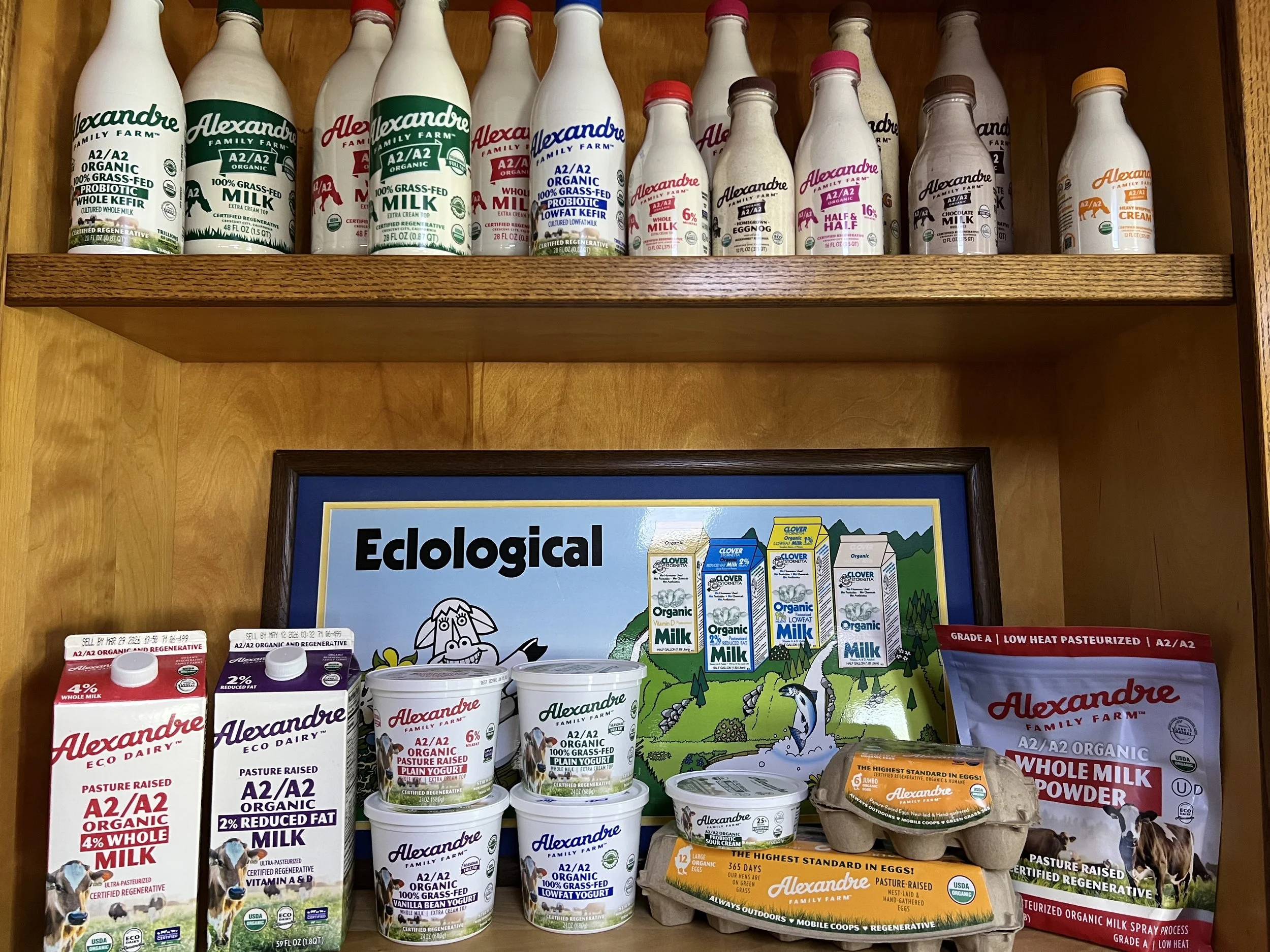
I've always loved their kefir, yogurt and milks, but during my time in California, I got to experience even more of what they offer, including their eggs, meat and cheese (only available in California!).
I just tried their chocolate milk and eggnog for the first time, and wow. I'm so impressed, from the flavor to the simple, quality ingredients. And it’s A2/A2, of course! The eggnog is also made with eggs from their own farm. No gums, no stabilizers, no carrageenan, no fake sugars.
These are the kinds of products I love finding because they're made with real ingredients I'd genuinely use to make the exact same thing at home.
You can also check out their recipes for more ways to use dairy: Alexandre Family Farm Recipes.
How to find out if it's you or the dairy
If you love dairy and want to enjoy its benefits but suspect you may have an allergy or intolerance, here's something to consider:
Try A2/A2 dairy from a source you trust (like Alexandre Family Farms) for a week or two.
Start with a small amount and gradually increase if tolerated.
Pay attention to how you feel and keep a simple symptom log.
If symptoms persist, consider other factors that may be contributing and explore different dairy options.
Still unsure? I cover other options, including raw milk and milk from different animal species, in my post on why quality dairy matters.
Final thoughts: food sovereignty
For me, an animal-based diet comes down to knowing the animal and knowing the farmer. And "what's wrong with me?" is sometimes a question about food quality, not just your body.
Maybe you were never the problem. Maybe it was the cow, the land, or the label.
Giving thanks
Thank you to the farms that work around the clock, 24/7, in every season, to put real food on our tables. Thank you to the people on the grounds checking on calves in the middle of the night, and to the families whose livelihoods and love for the land are behind every bottle. And thank you to the farms that still keep their doors open, so that a customer like me can walk in, ask questions, and see it for herself. That kind of openness is rare, and it's a big reason I trust the food.
Thank you, Stephanie Alexandre and the entire Alexandre crew, for the warm welcome, the memories, and the time you shared with me. And thank you for your commitment to producing consistently high-quality A2/A2 dairy, keeping that tradition alive, and giving more people the opportunity to explore a different relationship with dairy.
I’m grateful for the cows, the farmers, and the families gathered around tables full of food raised with care. And I’m definitely grateful for the high quality dairy i’ll be using to make all the treats and eggnog while the season lasts.