Beef Is Expensive, and the Bigger Problem Is How Fragile the System Is
If you've noticed ground beef prices climbing, you're not imagining it. U.S. beef prices are at record highs. At the same time, the Pentagon is reportedly preparing U.S. military bases to run at least 90 days without outside support, in case a major war cripples power grids and disrupts supply chains.
Those two stories look unrelated. They aren't. Both are about what happens when a system that everyone depends on is too concentrated to absorb a shock.
Why Is Beef So Expensive Right Now?
The cause isn't a single villain. It's a stack of problems that landed at once.
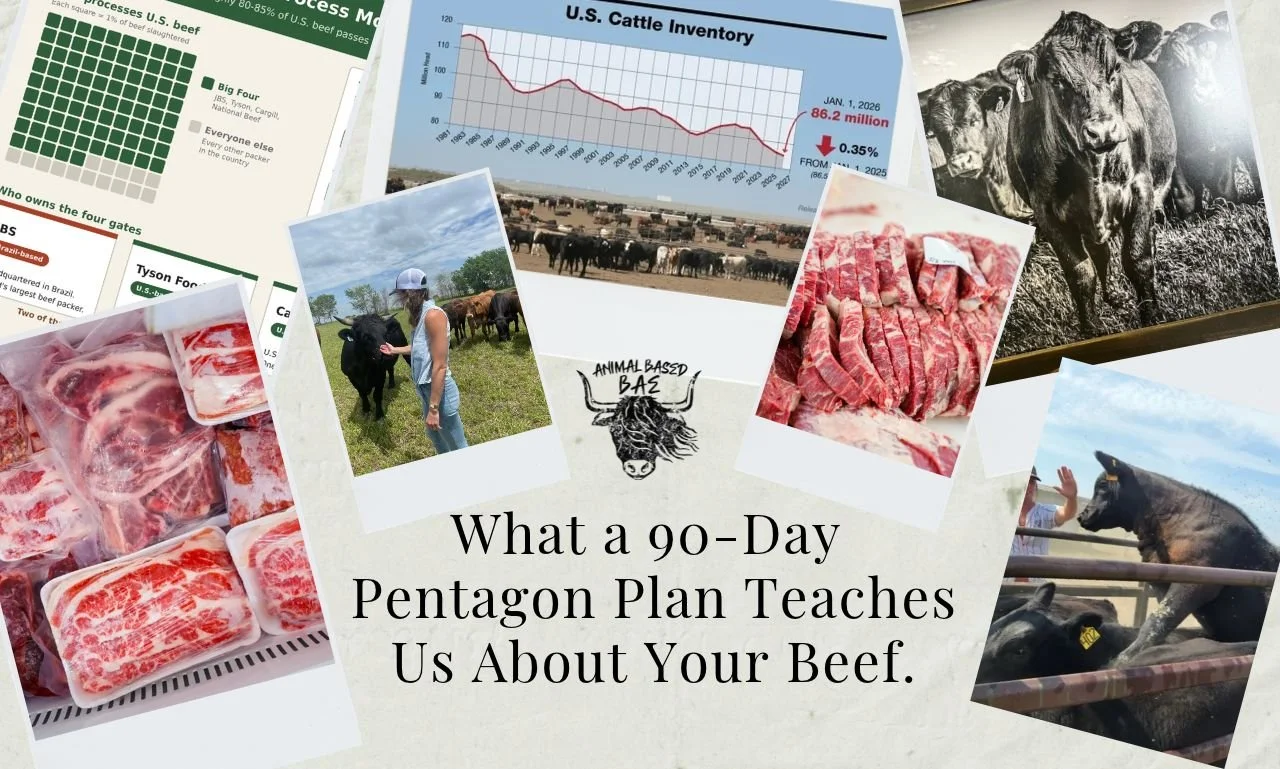
The core issue is supply. The U.S. cattle herd has been shrinking for years because of drought, high feed costs, and ranchers selling off breeding stock instead of expanding. By January 2026 the national herd had fallen to roughly 86.2 million head, the smallest since the 1950s. Fewer cattle means less beef, which pushes prices up. That would be true no matter who owned the processing plants.
There's a second layer that gets less attention:
who controls what happens to a cow between the ranch and your plate.
The Four Companies That Run U.S. Beef
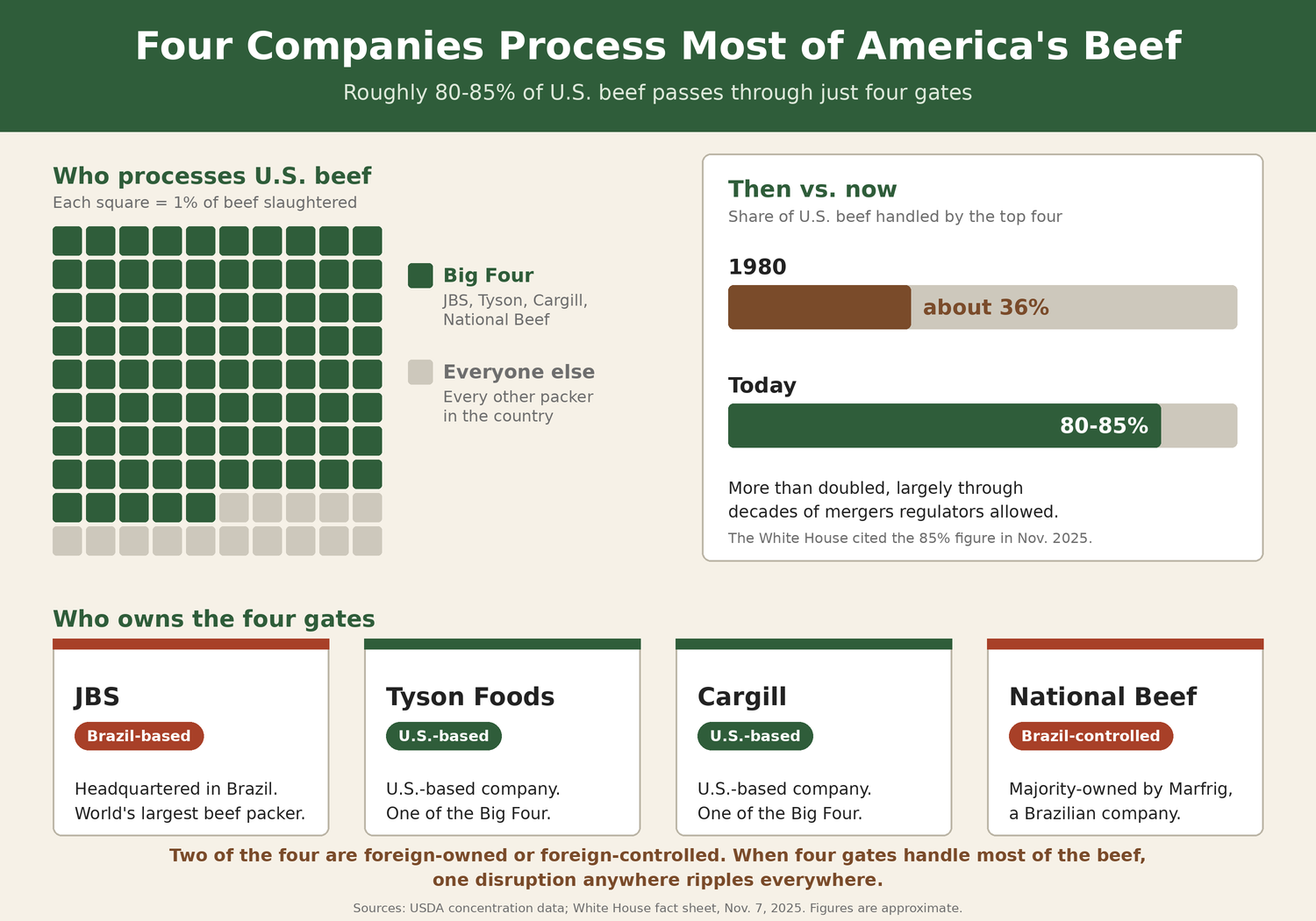
Four companies (JBS, Tyson Foods, Cargill, and National Beef) process roughly 80-85% of all beef slaughtered in the U.S., according to USDA data cited by multiple industry and government sources. In 1980, that concentration was around 36%. It has more than doubled, largely through decades of mergers that regulators allowed.
National Beef is majority-owned by Marfrig, a Brazilian company that acquired a controlling stake starting in 2018.
JBS is headquartered in Brazil and is the largest beef packer in the world.
Together, these four own more than 70 grocery-store meat brands, so much of the "choice" in the meat aisle comes from the same few owners.
This isn't a fringe claim. White House fact sheets have cited the 85% figure while directing the Department of Justice to investigate the industry for possible price-fixing and antitrust violations. Ranching groups like R-CALF USA publicly welcomed the probe and the industry has faced price-fixing litigation before, including a $52.2 million class-action settlement by JBS in 2022.
None of this proves illegal collusion. That’s still under investigation and the packers argue their margins reflect supply, demand, and operational risk. But the structural fact isn’t in dispute: when four companies control the bottleneck every rancher has to pass through, they have enormous leverage over both what ranchers get paid and what you pay.
It’s also worth knowing who those companies are. Two of the four, JBS and National Beef, are foreign-owned or under significant foreign control, a point the White House itself emphasized. They operate plants and employ workers here, but ownership and profits flow abroad. So when you buy a package of meat from one of their brands without checking the label, you’re directing your dollars to a company whose decisions are made elsewhere. A food system where much of the processing capacity is controlled by a few companies, some of them foreign, isn’t a resilient one.
What the Beef Import Expansion Actually Does
On August 26, 2026, President Trump signed Proclamation 11059, "Further Ensuring Affordable Beef for the American Consumer." It's often described as a tariff waiver, but technically it's a temporary expansion of a tariff-rate quota: the amount of beef allowed in at a low tariff before a much higher rate kicks in.
Here's how it works:
The window: September 1 through November 30, 2026.
The volume: up to 300,000 metric tons, released in three 100,000-ton tranches (September 1-30, October 1-30, and October 31 until filled or November 30). Access is first come, first served.
The product: only lean beef trimmings, the beef blended into ground beef. It does not cover steaks or other cuts.
The rate: eligible imports pay the low in-quota rate (about 4.4 cents per kilogram) instead of the 26.4% out-of-quota tariff.
Who qualifies: the "other countries" category. Countries that already hold their own U.S. quotas are excluded.
The price expectation: importers are encouraged, not required, to sell at 25% below the prevailing market price. USDA and the U.S. Trade Representative are monitoring prices, and the President can cancel the unused quota if the discount doesn't materialize. The White House hasn't publicly named the countries or companies involved in the deal.
This builds on a February 2026 move that expanded the tariff-free quota for Argentine lean beef trimmings by 80,000 metric tons a year.
Where It Stands Today
As of October 31, 2026, the program is still running. The third and final chunk opens today and closes when it fills or on November 30, whichever comes first. I found no announced extension, so unless something changes, it ends November 30.
So far, it hasn’t delivered. Importers brought in only about 38% of what was allowed in September, and shoppers haven’t seen much relief. One economist says retail beef prices barely moved. Another report found ground beef about 13 cents cheaper, which is tiny.
Why This Doesn’t Help the Herd
It pushes down what ranchers get paid. More imported beef competes with beef from American cattle, and ranchers feel that first. Lower prices at the ranch without lower prices at the store is the worst of both worlds.
It makes rebuilding the herd harder. Ranchers need to make money to hold back heifers and grow their herds. Anything that squeezes cattle prices works against that.
It runs through the same big companies. Imported beef gets blended into ground beef by large processors. Nothing in the policy helps small local processors or ranchers who sell directly to customers.
It’s a patch, not a plan. It ends in November and doesn’t touch the real problems: a shrinking herd and four companies controlling most of the processing.
Experts have said the same thing. Many economists believe prices are high because people kept buying beef as prices rose and cheaper imports don’t change that. Farm and ranch groups and lawmakers from cattle states have criticized it, saying it does nothing to rebuild the herd and could undercut ranchers trying to expand. Imports were already heading for a record this year, so this speeds up a trend that was already underway.
Cheaper imported trimmings might shave a little off a burger. They won’t add a single calf to the U.S. herd and they won’t change who controls the plants those calves pass through.
What You Can Do About It
Policy isn’t the only way to vote. Every time you buy beef, you’re casting a vote for the system that produced it. A generic package off the shelf almost certainly came through the same few processors. That’s why skipping the grocery-store beef and buying from a local rancher sends a different signal. It tells the market you want more ranchers, more regional processors, and more reasons to rebuild the herd.
The problem is that when so much of our beef flows through just four companies, a single disruption can shake the whole country. We saw it during COVID, when plant shutdowns left shelves empty. And that’s exactly the kind of weak spot the Pentagon is now planning around.
Why "More Imports" Doesn't Equal "More Food Security"
Food dependence and food security aren't the same thing. A country with a shrinking herd that leans harder on imports hasn't solved its production problem. It has outsourced it. Buying imported commodity beef doesn't rebuild the U.S. herd or strengthen independent regional processing. If that's your goal, your lever is where you spend your money.
Your Dollar Is a Vote, and Cheap Isn’t Always Cheap
Every time you buy beef, you’re voting for the system that produced it. Not in a dramatic way. Just in the way that money flows: to the ranchers who raised the animal, the plants that processed it and the companies that sold it.
When we buy whatever’s cheapest, we’re voting for the system that keeps prices low right now: big processors, imported trimmings, and thin margins for the people raising cattle. That feels like a win at the register. But a system squeezed that hard has no slack. Ranchers who can’t make money sell off their herds. Small processors close. A few big companies get bigger. And when something breaks, whether it’s a plant shutdown, a drought, or a disaster, there’s nothing to fall back on.
That’s the hidden cost of cheap. It isn’t free. We just pay it later, in higher prices when supply shrinks, in emptier shelves when something disrupts the system, and in fewer local options when the small operations are gone.
Buying local isn’t about being fancy or paying more for the sake of it. It’s about putting your money into a system with more than four gates between the ranch and your plate.
But I Can’t Just Pay More
That’s the honest problem. Groceries are expensive, and nobody should be guilted into spending money they don’t have. The goal isn’t to buy local beef at any price. It’s to shift some of your spending toward local, in ways that don’t blow up your budget.
Buy less beef, but better beef. Instead of eating beef five times a week from the grocery store, eat it two or three times a week from a local source. You spend roughly the same and send more of it where you want it to go.
Go in on a share with someone. A quarter or half animal is a big upfront cost, but splitting it with a neighbor, sibling, or coworker cuts that in half. Per pound, it often works out competitive with retail, especially for premium cuts. Ask the rancher for a per-pound price after processing so you can compare it with what you pay now.
Ask about the less glamorous cuts. Ground beef, stew meat, roasts, and shanks from a local rancher are usually far cheaper than steaks.
Use every part and stretch it. Rice, potatoes, and squash can carry a meal with a smaller portion of meat. Soups, chili, and slow-cooked roasts turn a little beef into several dinners.
Buy in bulk and freeze. If you have the freezer space, buying once a season is often cheaper than buying a little at a time. Just keep the disaster or outage point from earlier in mind.
Check the whole local network, not just beef. Farmers markets, CSAs, and co-ops can be cheaper for produce, eggs, and dairy, and shopping there builds the same local relationships.
Start small. If a share isn’t realistic yet, try one local purchase a month. Even one is a vote, and it gets you a name and a number for the next time prices change.
What Not to Do
Don’t skip meals or stretch your budget past what you can handle to make a point. A resilient food system needs resilient households too. Do what you can, where you can, and revisit it when your situation changes.
Why It Matters
None of us can rebuild the herd on our own. But when enough people shift even a portion of their spending, ranchers can afford to hold back heifers, regional processors can stay open, and the system gets more places for beef to go. That’s the difference between a food supply that bends and one that breaks.
The Bigger Question: What Does a 90-Day Plan Look Like for Food?
This is where the Pentagon news matters. Under the reported FORTRESS plan, every major installation in the continental U.S. would be expected to sustain essential operations independently for at least 90 days, including electricity, water, fuel and more. The 90-day standard is a reported requirement, not proof that bases already meet it.
Planning ahead for a disaster is smart. But notice the assumption behind it: the civilian systems everyone else relies on can fail, and stay failed for months. Bases are being told to plan for independence. The rest of us can't opt out of the food system.
We've already seen how concentrated processing breaks:
COVID plant shutdowns caused national meat shortages.
A cyberattack on JBS temporarily shut down a major processor.
Weather events have halted production in specific regions.
When a handful of plants handle most of the beef, one problem becomes everyone’s problem. Ranchers can’t move their cattle, and shelves empty faster than anyone expects. Planners call this a resilience problem. In plain terms, there are too few backup options at the bottleneck.
Why It Keeps Getting More Concentrated
This isn’t a conspiracy. It’s how the incentives work. Many big food companies are partly owned by large investors, like pension funds and index funds, that reward size, stability, and predictable returns. That pushes toward consolidation. Regional and regenerative farming focuses on healthy soil, healthy animals, and strong local economies, and those goals don’t always line up with maximum output and shareholder profit.
It’s a Matter of When, Not If
Another disruption will come. We just don’t know what or when. A storm, a cyberattack, a plant closure, a supply problem. The question isn’t whether to worry about it. It’s whether you’ll be ready.
Think of it like working out. You don’t train every day because you know exactly when you’ll need your strength. You do it so that when something happens to your health, your body can handle it. Resilience in food works the same way. You build it a little at a time, long before you need it.
So the question isn’t only “how do I stock my pantry?” It’s: if a military base needs 90 days of independence, what would that look like for the way we feed ourselves?
How to Actually Buy Local Meat
This isn’t complicated, but it takes a bit more effort than tossing a package in your cart.
I’m not a fan of typical commodity beef operations and feedlots, so when I look for beef I’m balancing two things at once: local and quality. The search terms below are how I found really good places near me. They’re meant to get you both at the same time.
For me, quality means cattle that are grass-finished and where I can find it, fed a corn- and soy-free diet. Corn and soy are the most common commodity feed crops, and the conventional versions are typically grown with herbicides and pesticides. Skipping them cuts down on that exposure unless the feed is certified organic, and I look for ranchers who choose their feed inputs on purpose rather than buying whatever is cheapest. That’s my approach, and you don’t have to follow it exactly. The point is to ask what the cattle are fed.
Step 1: Find real local sources
Generic searches surface grocery chains, not small ranchers. The trick is to search the way ranchers describe themselves.
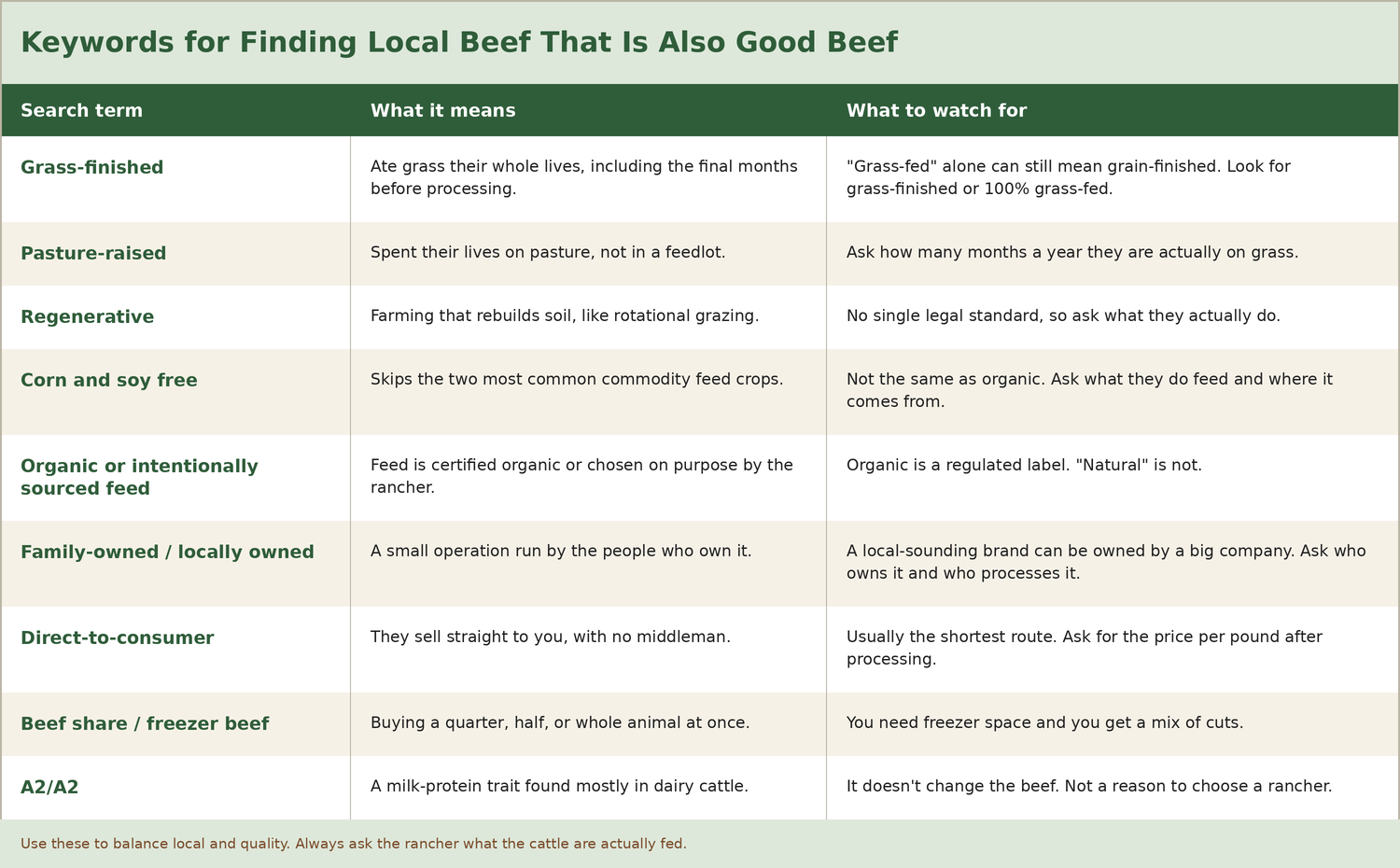
Whole-animal or custom orders: “[your county] custom meat processor,” “local butcher shop whole animal,” “[your state] beef share quarter half”
Grass-fed and regenerative: “[your state] grass-finished beef direct from farm,” “[your zip code] regenerative beef,” “[your state] pasture-raised beef farm”
Corn and soy free: “[your state] corn and soy free beef,” “[your state] grass-finished beef organic feed”
Producer directories: “[your state] beef council local directory” (most state beef councils keep one)
Co-ops and buying clubs: “[your city] food buying club,” “[your region] CSA directory,” “[your town] meat CSA”
Farmers markets: “[your city] farmers market meat vendors”
Directories worth bookmarking:
Eat Wild (eatwild.com): a long-running directory of grass-fed producers
American Grassfed Association (americangrassfed.org): producers who meet a certified standard
LocalHarvest (localharvest.org): farms, CSAs, and markets
Questions to ask a rancher:
Are the cattle grass-finished, or finished on grain?
What do you feed them, and where does the feed come from?
Where are they raised, and where are they processed?
Is the processor USDA-inspected or custom-exempt? (Shares sold before slaughter are often custom-processed. Individual cuts sold by the pound must come from inspected plants.)
What’s the price per pound after processing, all in?
How much freezer space will I need, and when is pickup?
Step 2: Understand the buying models
Quarter, half, or whole animal shares. Expect an upfront cost of roughly $800-$2,000+, but the effective price per pound on premium cuts is often lower than retail once averaged out, and a share typically lasts a household 6-12 months. You need freezer space, and you get a mix of cuts rather than choosing exactly what you want.
Splitting a share. Going in with a neighbor, sibling, or coworker halves the upfront cost and the freezer problem.
Meat CSAs and subscriptions. A smaller, regular supply with less upfront commitment, usually at a smaller discount than a bulk share.
Asking restaurants where their beef comes from. It doesn’t fill your freezer, but demand shapes supply.
A resilience note: a freezer full of beef is a real buffer, but it depends on power. If you’re building a buffer, think about how you’d keep it cold in an outage or pair it with shelf-stable options like canned, dehydrated and dried goods.
Step 3: Keep a directory of sources you trust
Once you find a rancher or farm you like, write it down: the name, where they are, what they sell, how to order, and the price per pound. Next time you need to restock, you’ll already know who to call.
You can find more of the farms I trust on my favorites page.
The Bottom Line
High beef prices are the visible symptom of two related problems: a genuinely smaller national herd, and a processing industry so concentrated that four companies, two of them foreign-owned, handle most of the country’s beef.
The temporary import quota, set to end November 30, was supposed to bring prices down. So far, the results have been modest and some economists say it has pushed cattle prices down for ranchers without making beef cheaper at the store. It’s a short-term patch on a long-term problem. It doesn’t add a single calf to the herd, and it doesn’t change who controls the plants.
The Pentagon’s 90-day planning points to a bigger truth. Disruptions aren’t a question of if, but when. We’ve already seen what happens when a few plants go down. Resilience can’t be built only one pantry at a time. It’s built by having more than four gates between the ranch and the plate: more regional processors, more direct relationships, and more pricing power for the people raising the food.
That’s where your dollars come in. Every time you buy beef, you’re voting for the system that produced it. Cheap now isn’t always cheap later. A system squeezed to the lowest price has no slack, and we pay for that in higher prices, empty shelves, and fewer local options when something breaks.
Buying local won’t fix beef prices nationally, and you don’t need to do it all at once. Start small: one purchase, one split share, or one rancher you get to know. Ask what the cattle eat. Look for local and quality together. Then build your buffer the same way you’d build strength, a little at a time, before you need it.