Shorter Days Ahead: My Light, Food, and Sleep Plan
The days are getting shorter, and I notice it in my energy, my appetite, and how I sleep. Clocks fall back on November 1, so the evenings are about to get dark even earlier. Every year around now I get asked the same thing: what do you do about vitamin D?
Here’s my answer: vitamin D tracks the sun, and the sun changes with the seasons, so a somewhat lower winter level is largely your body following the season, not a malfunction. A blood number is also just a downstream marker. It reflects sun, skin, body fat, food, and illness all at once, and chasing it with a pill ignores everything that put it there.
So, I don’t think of it as the only number to push up. For me, vitamin D is part of a bigger cycle where light, food, sleep, and the seasons all work together. In winter, the question I actually ask myself is “how do I make sure I’m not suppressing my melatonin?” That’s why I focus on three things: light, food, and sleep.
Stay with me to the end, because I'll also talk about why this is so hard in a modern world that wants everything optimized all year, with no slow season, and what I think we lose when we chase a number instead of the rhythm.
1. Light: get it early, skip the junk light after dark
Daylight first. I aim to get outside for morning light, as close to sunrise as I can, because that first light sets your circadian clock for the day. I know not everyone can do this, but if you're up at that hour, get outside before you reach for electronics. I go out every morning, even when it's cold, cloudy, or rainy, and I sprinkle more time outside throughout the day. Outdoor light, even on an overcast day, is many times brighter than the light inside most homes, and it helps set your body clock and your digestion. That supports better sleep and a healthier hormone rhythm. I also aim to get midday sun on my skin. I also don’t own sunglasses, and I would especially skip them during the crucial early part of my morning outdoor time (without staring directly at the sun), because light reaching your eyes is what sets your body clock.
One honest note: in winter, much of the US, especially the northern half, doesn't get enough UVB for your skin to make much vitamin D. So winter daylight mostly supports your body clock, and food and whatever is left of your stored summer vitamin D do more of the vitamin D work. That's part of why the next section matters.
No overhead lights after sunset. I almost never use my overhead lights. During the day I let natural light come in through the windows to light the house, and after dark I keep the overheads off. Bright light, and blue-heavy light from screens and cool-white bulbs, can suppress melatonin and make it harder to fall asleep. It isn't just about alertness. It's about the signal: when the sun goes down, our bodies naturally wind down, and interfering with that cycle affects circadian rhythm and hormone health, not just how awake you feel. So once the sun goes down, I keep things dim and use red light. You honestly feel a pretty immediate change with this one, because the blue light is no longer telling your body it should be awake.
For getting around at night, I use BON CHARGE motion sensor red night lights (code: BAE15). They come on when I move and fade back to dark afterward, so I never have to flip on a bright light for a trip to the kitchen or bathroom. They give off red light with no blue or green wavelengths, and they're rechargeable and portable, so they're easy to take along when I travel. Red lights and blackout shades are a must when I travel. I'd take them over another outfit any day. They're the number one priority in my bag.
2. Food: nourish the whole cycle
When I think about winter food, I'm not asking "how do I get my vitamin D up?" I'm asking "what does my body need to run this whole cycle well?" The same handful of whole foods answers a lot of those questions at once. Fatty fish, eggs, dairy, and organ meats give you protein (the raw material your body uses to make serotonin and melatonin), B vitamins, minerals like calcium, magnesium, and zinc, omega-3 fats, and some vitamin D. The point of real food is that it delivers all of those pieces together.
Vitamin D and calcium are one example of that teamwork. Vitamin D helps you absorb calcium, so when your D dips in winter, getting enough calcium from food matters more. It also keeps your body from having to pull calcium from your bones to hold your blood levels steady. Calcium plays a role in your nerves and muscles, and it's involved in how your brain turns tryptophan into melatonin. The research linking calcium directly to better sleep is limited, so I don't treat it as a sleep fix. I think of it as one supporting piece. I lean on egg yolks and fatty fish for vitamin D (and will also be adding Cod Liver oil), and on dairy and sardines with the bones in for calcium. Sardines cover both.
Here are the foods I rely on. I've listed them roughly in order of how much vitamin D they contain, but each one brings more than that:
Cod liver oil: This one is new for me, since I finally found a brand I'm comfortable trying. It's the most concentrated food source. A single tablespoon can cover more than a day's recommended vitamin D, but it's also very high in vitamin A (see the vitamin A note below, which also covers pregnancy). I'm planning to try Rosita through Perfect Supplements (use code: BAE10).
Fatty fish like salmon, trout, mackerel, herring, and sardines. I get most of my fish from Seatopia (use code BAE20) because they test rigorously for contaminants like heavy metals, microplastics, and BPA. I'm still looking into more sourcing options, because I'm cautious about the tinned fish you find in typical grocery stores and the contaminants that can come with it.
Fish roe and caviar, which have some vitamin D along with other nutrients. Again, Seatopia is my go-to.
Oysters and tuna, which have smaller but real amounts.
Egg yolks, especially from pasture-raised hens that get outdoor sun. Each yolk has only a modest amount, so it adds up over a week rather than in one meal.
Beef liver, which has a small amount of vitamin D alongside a lot of vitamin A, B12, and iron.
Butter and other pasture-raised animal fats, which have small amounts that depend on the animal's sun exposure.
For calcium, dairy is one of the most absorbable and easiest ways to get enough, and many of us fall short. It also brings protein and other minerals along with it. Whole, reduced-fat, and nonfat dairy all deliver it. I break down how I choose between them in my whole, reduced, and nonfat dairy guide, and I source my dairy from Triple E Farming, which is running 20% off raw milk through October 31, 2026 (code: BAE25).
Timing matters too. I finish my last meal around 4:30 or 5, so my body isn't busy digesting when it should be winding down.
Everything in this section is part of how I eat day to day, and I lay out the full picture in my animal-based diet guide. Fatty fish, eggs, dairy, and organ meats bring vitamin D, calcium, magnesium, and protein together without me having to piece it all together from separate bottles.
A note on vitamin K2. Vitamin D helps you absorb calcium, and vitamin K2 helps direct where that calcium goes. It activates proteins involved in putting calcium into bone and keeping it out of soft tissues like your arteries, which is why you'll see D3 and K2 sold together. The research on the combination is promising but still developing, so I don't treat it as a magic pair. I like getting K2 from food, where it comes alongside the fat it needs to be absorbed: egg yolks, grass-fed butter and ghee, aged cheeses, and organ meats like liver.
A note on vitamin A. Liver and cod liver oil are both rich in vitamin A. The official limits are conservative, and a normal serving of liver a week is fine for most people, but I won't stack them daily. For me, that looks like a teaspoon of cod liver oil on some days and about 2 oz of liver on others, without obsessing over it.
A note on pregnancy. Look, nothing in life is risk-free. Mainstream guidance advises limiting liver and high-dose cod liver oil, and it advises avoiding raw milk and raw fish, because pregnancy raises the risk of birth defects and infections. I know my approach is the opposite of Western advice: if I were pregnant, I'd likely still eat liver and choose raw milk and sushi from sources I trust. I don't think any choice in pregnancy is risk-free, so it's about weighing the tradeoffs for yourself. This is my personal view, not medical advice. Talk with your provider and do what you're comfortable with.
3. Sleep: it's all part of the same cycle
Light and food only go so far if sleep falls apart. Low vitamin D and poor sleep have been linked in research, though that's an association, not proof of cause. And when sleep is interrupted, it causes far more than the obvious tiredness, sluggishness, and running below capacity. It hits metabolic health and food choices, and it interferes with the repair work your body is supposed to do overnight, like cellular clean-up and the glymphatic system (I wrote a full blog on how your brain detoxes while you sleep).
Why melatonin is my winter focus. As nights lengthen, your body naturally makes melatonin for longer. Winter is working with you, as long as you don't get in the way. Since I can't make much vitamin D from sun in winter anyway, the lever I can control is protecting that melatonin: bright light early to anchor the clock, and dim, red light after sunset so the evening signal isn't overridden. It's not either/or, since food still covers vitamin D, but if I'm picking where to put my effort in winter, it's the light.
What melatonin actually does. Melatonin gets treated as "the sleepy hormone," but that undersells it. It's your body's darkness signal: it tells every system when night has started, which keeps your circadian rhythm on time. Research also points to it acting as a powerful antioxidant that protects cells, including the mitochondria, and supporting immune function and the overnight repair work I mentioned. Your pineal gland makes the nightly rise, and bright or blue-heavy light after dark is what suppresses it. That's why I think of melatonin as the foundation, with vitamin D as one piece that sits on top of it.
Here's how I protect my sleep as the days shorten:
Morning and daytime light to anchor my body clock and my digestion. Digestion can also affect circadian rhythm, so these work in sync.
Dim, red light after sunset instead of overhead lights and screens. Avoiding electronics for a few hours before bed is a good goal, but I know it's not always achievable, so at least protect yourself with the light.
A warm Epsom salt bath a few nights a week (not every night), an hour or two before bed, under dim or red light. The warmth helps your body temperature drop afterward, which supports falling asleep, and the magnesium may add to the calming ritual.
A dark room with only my motion-activated red light for night trips.
Bedtime around 9 pm, with my last meal at 4:30 or 5.
Temperature around 69°F for bedtime, because your body temperature drops as you sleep, and a cooler room supports more restful sleep.
Every little light covered or blocked, even harmless-looking night lights. Blackout shades are a must, especially if neighbors' lights beam through your window.
No electronics, TVs, or EMFs of any kind in the room.
An air purifier in the room. Indoor air can carry VOCs, mold, and off-gassing from furniture, and your body is doing its repair work while you sleep, so I want that air as clean as possible. I use JASPR in my bedroom and kitchen, the two rooms I think matter most. (use code: ANIMALBB for a deal)
Want the full sleep toolkit? This post is about how light, food, and sleep fit together as the days shorten. In Sleep Without Compromise, I go much deeper on the sleep side, with things I only touch on here: how I time my meals, why I use sauna in the evening (or a warm wind-down like the bath above), how indoor air quality affects my sleep, my blue-light and red-light gear, and the habits I'd drop first if you want better sleep. If you want the step-by-step version, start there.
I take my sleep seriously. It's my healing capsule.
Good sleep, real food, and real daylight feed each other, which is why I'd rather work on the whole cycle than chase a single number.
What most people don't know about vitamin D
Vitamin D isn't a vitamin the way vitamin C is. Your body builds it, stores it, and activates it, and the starting material is cholesterol.
It starts with cholesterol. Your skin holds a cholesterol-based compound called 7-dehydrocholesterol. When UVB light hits it, it converts to vitamin D3. Your liver then turns D3 into the form a blood test measures, and your kidneys make the active hormone form. So vitamin D is really a hormone built from cholesterol, which is one more reason I'd rather think about the whole system than one isolated number.
A quick note on cholesterol. Most of your body’s cholesterol isn’t from your plate. Your liver and skin make the bulk of it, and for many people the body adjusts its own production as intake changes. That doesn’t make food cholesterol irrelevant: eggs, liver, and shellfish deliver it alongside nutrients like choline and B12, which is why I still encourage to eat them. That’s a bigger conversation for another blog.
UVB vs UVA, and why windows don't count.
UVB is the part of sunlight that makes vitamin D. It's also the part that burns, so I aim for short, no-burn exposure rather than long sessions.
UVA is present all day, passes deeper into the skin, and does not make vitamin D.
Window glass blocks most UVB but lets UVA through. Sitting in a sunny window is great for your body clock, but it doesn't count toward vitamin D.
UVB needs a high sun. It's strongest around midday, in spring and summer. A rough rule of thumb is that if your shadow is longer than you are, there's very little UVB.
Other things that cut production: sunscreen, clouds, smog, darker skin (which needs longer exposure), and age.
How stored vitamin D works. I think of it like a bank account:
Summer deposit. Midday sun on bare skin makes D3 from cholesterol.
Storage. Vitamin D is fat-soluble, so your body holds it in fat tissue and the liver and releases it slowly.
Fall and winter withdrawal. The circulating form has a half-life of roughly two weeks, so with no new deposits your blood level drifts down. It typically bottoms out in late winter, which is why summer storage carries you partway, not all the way. This drift is part of the cycle, not a failure.
Food keeps the account from running dry. Small, steady deposits from food slow the drop.
How it works with your diet. Vitamin D still matters. I just don’t think it’s the only thing to chase. These are the foods doing the heavy lifting, so you can see where it comes from. Food won't replace summer sun in one meal, but it adds up. These are rough figures (approximate, from NIH data) next to the adult recommendation of 600 IU a day (800 IU after age 70):
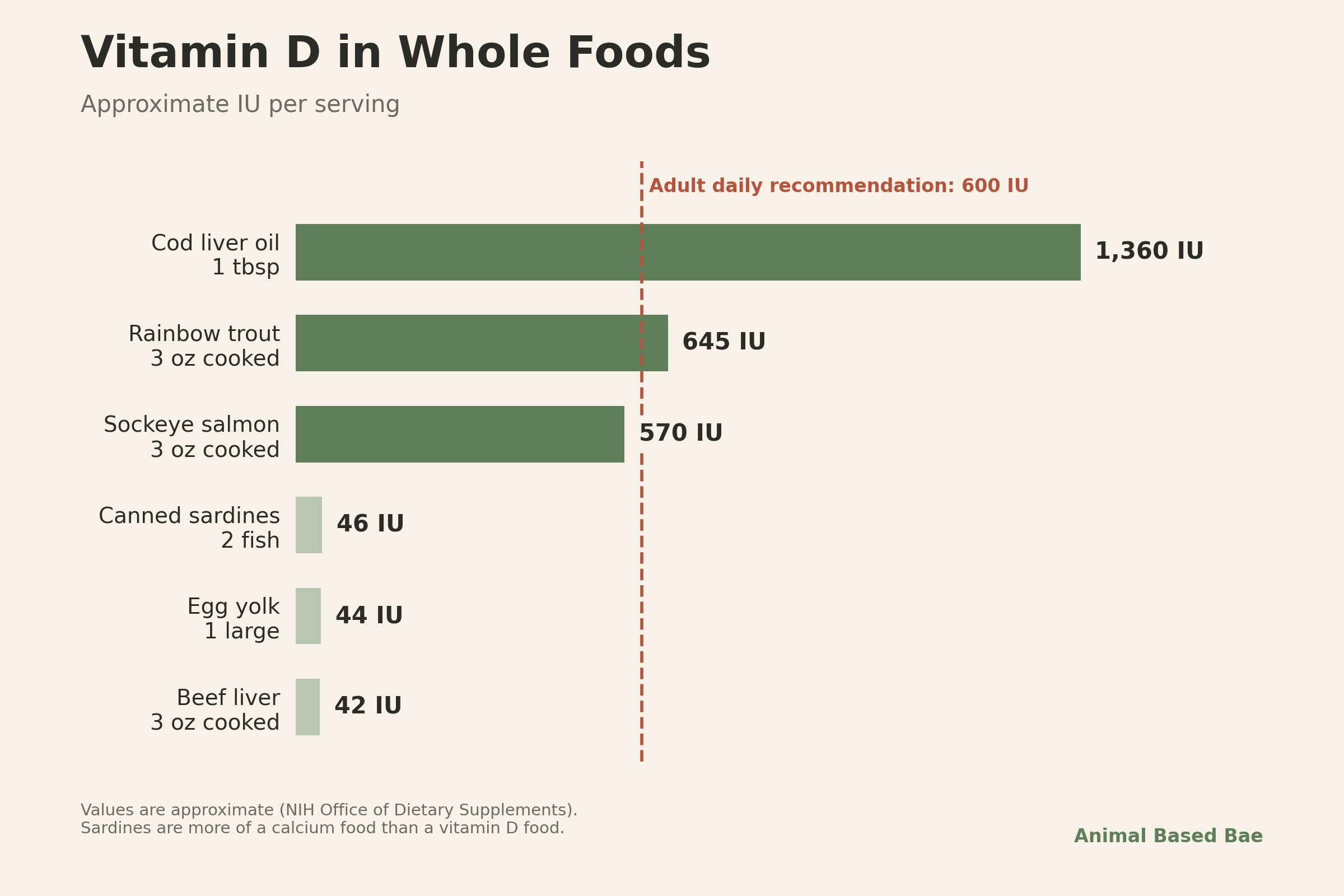
Two things stand out. Sardines are a calcium food more than a vitamin D food, and egg yolks and liver are small daily deposits, not big ones. The big contributors are cod liver oil and fatty fish, which is why I lean on them more from November through March. Because vitamin D is fat-soluble, it absorbs better alongside fat, which fatty fish, cod liver oil, and egg yolks already have built in. Magnesium is also needed to activate vitamin D, and seafood and dairy both contribute some.
Why I stopped chasing vitamin D
A vitamin D number is a snapshot of a rhythm, not a score to win. Your levels are meant to rise through summer and drift down through winter, because the sun is the main trigger and the sun changes with the seasons. When my winter number is lower than my summer one, I don’t see a problem to fix with the biggest pill I can find. I see a body following the season.
Here’s why I don’t treat it as a number to push up:
It’s a marker, not the whole story. Your level reflects sun, season, skin, body fat, and food. Illness and inflammation can also pull it down, so a low number can be a result of something else, not just a cause.
The research is mixed. Low vitamin D has been linked to plenty of health problems, but when large studies gave healthy people high doses, most didn’t find the big benefits the links suggested.
The habits do more than one job. Morning light, fatty fish, eggs, and dairy also support sleep, calcium, and your body clock. That’s why I’d rather build the whole cycle than chase one number.
I’m not saying a supplement is never useful. If you’re very low, older, have darker skin in a northern climate, rarely get outside, or have a medical reason, your situation may be different. But for most of us, the goal isn’t a higher number. It’s a steady rhythm.
When is a low number more than a winter dip?
A lower winter level is normal. Here’s what might suggest it’s more than that:
Fatigue or low energy that doesn't match how you're sleeping
Aching bones or a sore lower back
Muscle weakness or aches
Low mood, especially through the darker months
Getting sick more often or taking longer to recover
Slow wound healing
Hair thinning
The catch is that these are nonspecific, and many people with low vitamin D have no symptoms at all. They overlap with poor sleep, stress, and low iron or B12. If you want a real answer rather than guessing, a blood test is the only way to know, and you can order one yourself through an at-home kit. If you have persistent bone pain or real muscle weakness, this could definitely be your sign to test.
My takeaway
The goal isn't a higher vitamin D number. It's a steady rhythm.
Vitamin D is one piece of a bigger cycle. Morning light sets your clock, real food gives your body the building blocks, and darkness at night protects the melatonin that ties it all together. When those three line up, a seasonal dip in vitamin D is usually just your body following the year, not a problem to fix with the biggest pill.
We also live in a world that wants everything optimized all the time, with no dips and no slow seasons. But winter is built to slow us down: earlier nights, more rest, simpler routines. I'd rather work with that than fight it. A supplement can raise a blood number, but a number isn't the same as feeling well, and large trials haven't shown that pushing generally healthy people higher improves their health. More isn't automatically better either, since very high levels carry their own risks. I can't tell you that keeping your level artificially high all year will cost you later in life, because nobody has shown that. But I do think it's worth asking what we lose when we chase a number instead of honoring the rhythm behind it.
So keep it simple, consistent, and sustainable. One good night won't change much, and neither will one perfect week. Stay with it for months and watch what happens to your energy, your mood, and your sleep. Switching to red light after sunset can feel different almost right away, while training your body into the full rhythm takes a little longer, though not too long, because sleep responds faster than most habits.
Go outside early. Eat real food. Protect your dark.
Let the season do what the season does.