Dairy Fat Guide
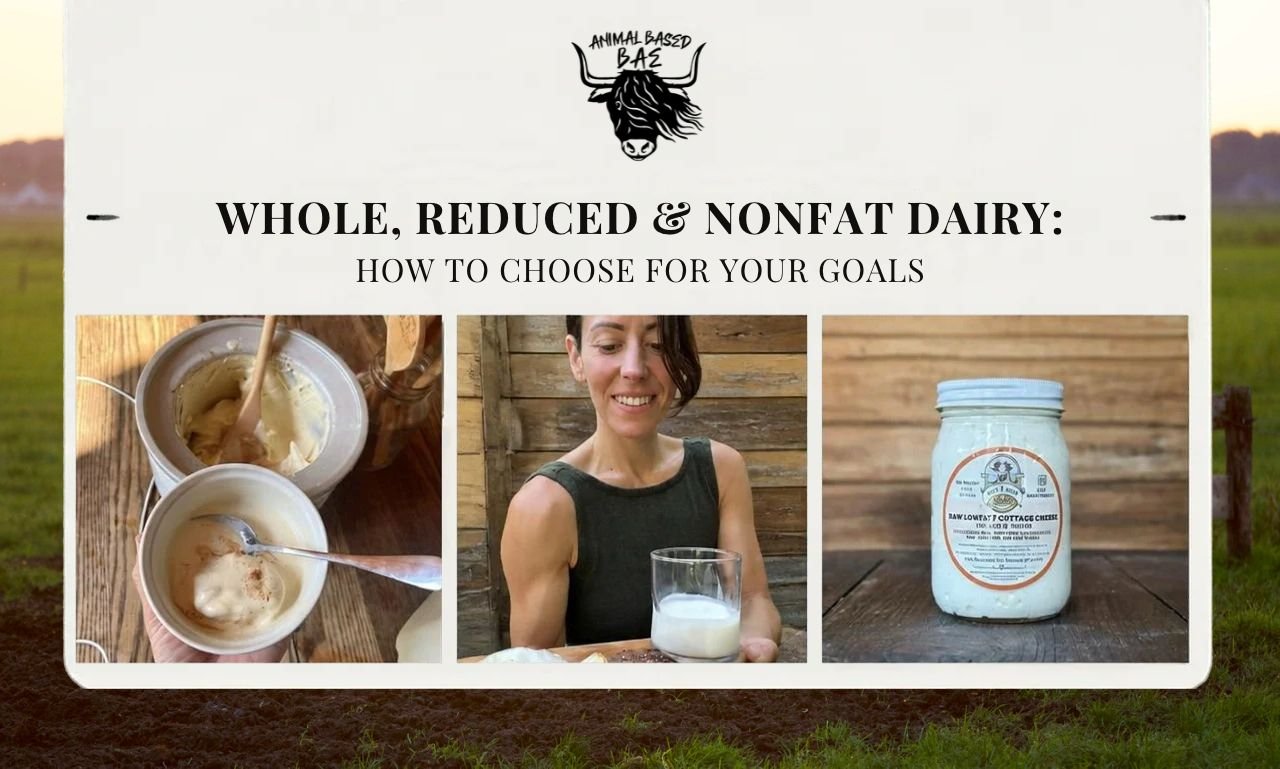
Whole Fat, Reduced Fat, Nonfat Dairy: They're All Great, Here Are the Details
I eat dairy in a lot of different forms, and I get asked all the time why I sometimes drink skim, or which type is “best.” Whole milk or nonfat? Raw or pasteurized? Full-fat yogurt, reduced-fat, or Greek? My honest answer is that they’re all great, and the right one depends on what you’re doing that day, that week, and in that recipe.
If you enjoy dairy and tolerate it well, there’s room for whole, reduced-fat, and everything in between. It comes down to balance, your goals, and knowing what’s going on with your food.
This blog post is all about macros, goals, and having fun in the kitchen. For a deeper dive on sourcing, including why quality, raw, different animal milks and why A2/A2 dairy matter and how to find good sources, read my full breakdown here.
“Humans shouldn’t drink milk.” Let’s talk about this first.
You’ve probably heard it: we’re the only species that drinks another animal’s milk, so we shouldn’t. It sounds convincing, but it doesn’t hold up. We’re also the only species that cooks food, makes cheese, and drives to the grocery store. “Other animals don’t do it” isn’t a nutrition argument.
Here’s what’s actually going on. Many people lose some of their lactase (the enzyme that digests lactose) after childhood. But a large share of adults, especially those with Northern European and some African and Middle Eastern ancestry, keep producing it for life. Many people who make less lactase can still handle fermented dairy like yogurt and kefir, or aged cheeses that are naturally low in lactose.
Quality and processing matter here too. Ultra-high-temperature (UHT) pasteurized milk is heated much more intensely and has no live bacteria left, while raw milk still contains them. Many people I’ve talked to say they tolerated raw milk far better than store-bought, and some found they weren’t truly lactose intolerant after all. My other post goes into more detail on this.
So the real answer is that it varies from person to person, not that humans can’t have milk.
And here’s the part that makes me tilt my head: we’re told to avoid one of the most concentrated, easily absorbed sources of calcium, while many people fall short of their calcium needs. If you tolerate dairy, cutting it out without a plan to replace that calcium can leave a real gap. If you don’t tolerate it, that’s valid too, and I’ve got other options for you below.
The case for whole-fat dairy
In its whole form, like whole milk or full-fat yogurt, dairy gives you the full package: fat-soluble vitamins, minerals, protein, and, in fermented dairy, beneficial bacteria. I think of whole foods as nature's design. The components work together in ways an isolated nutrient or supplement can't replicate. A calcium pill and a bowl of full-fat yogurt are not the same thing.
When I want the most nutrient density, or I'm simply eating for nourishment, this is where I go.
The case for reduced-fat and nonfat dairy
Here's where macros come in. If you're cutting or maintaining, lower-fat dairy gives you control. You keep the foods you love and the protein you need without the extra calories from fat.
It still delivers plenty:
Protein to support muscle and keep you full
Calcium, which supports strength, muscle contraction, and nerve function, and which many people don't get enough of
B vitamins and minerals your body needs to run well
Skim milk is a simple example. A cup has about the same protein and calcium as a cup of whole milk, but around half the calories. You do lose some of the fat-soluble vitamins that travel with the fat, which is part of why I love whole dairy too, but the protein, calcium, and B vitamins stay put.
Let's talk about processing (and playing with your food)
Take Greek yogurt. It's made by straining regular yogurt to remove the whey, which gives you that thick, creamy texture and a higher protein count. That's also where the trade-offs come in. Straining lowers the lactose, but it also removes some of the liquid that holds minerals, B vitamins, and part of the cultures, so you don't get the full package you'd get from plain yogurt. How it sits with your digestion depends on your body.
The more a food is processed, the further it gets from its whole form. But there's room for that, especially in the kitchen. I love Greek yogurt when I need a specific texture. I recently made a frosting for a carrot pie I was testing, and the thick consistency was perfect. Is it the same as a bowl of plain whole-milk yogurt in its natural form? No, and it doesn't have to be. You can enjoy dairy in its most natural form and use it creatively when you're developing recipes. Both can exist, as long as you know what's going on.
I make the same kind of call with heat treatment. When I’m drinking milk or eating dairy as is, I go raw, because that’s where I want the live enzymes and cultures. When I’m baking, I use low-temp pasteurized, or pasteurized since the oven’s heat would pasteurize raw milk anyway. It’s the same idea as choosing full-fat or nonfat: match the milk to the job. I go deeper on raw, low-temp, and A2 in my sourcing post.
Whichever style you choose, where it comes from matters. I source my dairy from Triple E Farming, and starting with a quality farm means every option on the table, whole, reduced, or nonfat, is a better version of itself.
Balance your fat across the whole day
Your goals and your waistline come from intentional consumption. For me, that means thinking about where my calories come from across the whole day, not just at one meal.
I get a lot of my fat from things like ground beef, so if I’m eating full-fat dairy at every meal plus 85/15 ground beef, it adds up quickly. Leaning on lower-fat dairy at some meals lets me keep a healthy fat intake without overshooting my calories. On other days, when I’m eating leaner proteins like chicken or shrimp, that’s a great day to enjoy the full-fat dairy. It’s not about restricting. It’s about being strategic so I can enjoy all of it.
Why calcium matters for your goals (and why so many of us fall short)
Calcium does far more than build bones. It’s involved in muscle contraction, nerve signaling, and how your body stores and uses fat. Research suggests higher-dairy diets during a calorie deficit may support fat loss, likely because dairy provides calcium alongside protein and other nutrients. Dairy doesn’t override energy balance, since you still need a deficit to lose fat, but what you eat within that deficit matters.
Here’s what makes this a bigger deal than most people realize. In national survey data (NHANES) on adults 18 to 69, about 63% didn’t meet the 1,000 mg recommendation, including roughly 72% of women and 53% of men. It gets worse with age: in one analysis, only 15% of men and 8% of women over 71 met the recommended intake from food. Calcium has also been flagged in the Dietary Guidelines as a nutrient of public health concern because of under-consumption.
So why is this so common? A few likely reasons:
Less dairy overall. When people cut milk, yogurt, and cheese, they lose their most concentrated calcium sources. Many cut dairy because of digestion issues or weight loss goals, but the answer may be getting more intentional instead of cutting it entirely: choosing quality sources and using whole, reduced-fat, and nonfat dairy strategically.
Swaps that don’t match up. Plant milks get their calcium from added, isolated forms, and it tends to settle at the bottom of the carton. They also lack the protein and other nutrients dairy brings along.
Eating less in general. In a long calorie deficit, it’s easy to under-eat calcium along with everything else.
Relying on a pill. Supplements aren’t a guaranteed fix. In one national survey, only about half of supplement users actually reached an adequate intake.
Quality is a separate conversation. Pasture-raised, well-managed dairy tends to look different from conventional milk in things like fatty acid profile and some vitamins, and it’s a big reason I source from Triple E Farming. But the amount of calcium you get is mostly about how much dairy you eat, not where it came from. If you’ve avoided dairy because of gut, skin, or other health concerns, I’d look at the type and source before writing off the food entirely. The best strategy is a quality source and enough servings across the day.
What 1,000 mg of calcium looks like:
1 cup of milk (about 300 mg)
1 cup of plain yogurt (about 300 mg)
1½ oz Swiss cheese (about 340 mg)
½ cup of cottage cheese (about 100 mg)
Reduced-fat and nonfat dairy count too. Calcium isn’t in the fat, so skim milk and nonfat yogurt have about the same amount as their whole-fat versions, and sometimes a little more per cup. That makes them an easy way to hit your calcium while keeping calories in check.
Spread these across your day around your calories and macros. If dairy doesn’t work for you, you have other options. I break down more high-calcium foods, like sardines with the bones in, in this post.
Final thoughts
You don’t have to pick a team. Whole dairy when I want the full nutrient density, lower-fat when I’m being intentional with macros, pasteurized for baking, and Greek yogurt when a recipe needs it. They’re all great, and they’re all meant to be enjoyed.
Here’s what I really want you to take away: whatever fat level you choose, don’t lose the calcium. So many of us fall short, and dairy is one of the most absorbable and easiest ways to close that gap. Whole, reduced-fat, and nonfat all deliver it, so you can shape your dairy around your goals without giving up the benefits. Choose what works for your body, start with a quality source, and have fun with it.
Want to try raw milk from the source I use?
Triple E Farming is running 20% off raw milk from now through October 31, 2026. Use my link and code BAE 25 at checkout.