Salt: What's Really in Your Salt, and How Do You Choose a Better One?
Salt is one of the few ingredients most of us use every day without a second thought. But how much do we actually know about what's in it?
If you're looking for the best salt for a carnivore or animal-based diet, or wondering about heavy metals and microplastics in sea salt, this post breaks down what I've found.
This question matters especially if you follow a carnivore or animal-based diet, train regularly, use the sauna or sweat heavily. Sodium is an essential electrolyte, and when you're deliberately consuming more of it, quality and sourcing matter just as much as quantity.
I've spent far more time researching the quality of my meat, dairy and eggs than I have my salt. The recent Maldon situation changed that. It reminded me that even with something this simple, there can be more to the story than the packaging suggests. That's why I like to know the producers behind the foods I recommend, and why I pair that with transparent lab testing. One without the other isn't enough.
So I've taken a closer look at where different salts come from, how they're harvested and processed, and what might be coming along for the ride, including heavy metals (lead, arsenic, cadmium, mercury), microplastics, mineral content, iodine and how open brands are about their testing.
This post is a snapshot of that research. I haven't found the perfect salt, but I'll share what I've been using, what the publicly available testing shows, what I'm still exploring and the questions I still have.
Whether you're animal-based, active or simply want to be more intentional about what's in your kitchen, let's get into it.
The Short Version
If you don't have time to read the whole article, here's what I want you to take away:
Natural, ancient, unrefined and mineral-rich don't automatically mean a salt is free from unwanted contaminants.
Sea salt and mined salt can each have different potential contaminants. Neither source guarantees purity.
Independent laboratory testing, clear sourcing and transparency matter more to me than marketing claims.
Mineral-rich salt isn't necessarily a meaningful source of minerals in the quantities we typically consume.
Most specialty salts aren't iodized, so iodine deserves separate consideration.
Knowing the producer and understanding how the salt is harvested and processed are also important.
One laboratory result is a snapshot of one sample, not a guarantee about every package.
Why I'm Finally Taking a Closer Look at Salt
When I feature something on my Favorites page, I want to go beyond what a company says about itself. I like to meet the founders and producers, visit their farms or facilities when I can, and ask questions face-to-face.
With salt, I haven't done that yet. I haven't visited the producers or seen their harvesting and processing firsthand. So far, my research comes from company information, publicly available lab reports and conversations with a few producers.
The Maldon situation brought this into focus. A label with a place of origin can make you assume you know where everything comes from, but the finished product, the raw ingredients and the manufacturing process can tell different stories.
I also want to be clear that relationships aren't a substitute for testing. A producer can be wonderful and still make a product that needs a closer look.
For now, I'm doing the research, asking questions and keeping an open mind. I'm not calling any of these the cleanest salts or giving them my full endorsement, and I'll update this article as I learn more.
Why Salt Matters Even More When You're Eating Whole Foods
If you've moved to a carnivore, animal-based or other whole-food way of eating, salt may play a different role in your day. Most of the sodium in a typical diet comes from processed and packaged foods, so cutting those back can lower your intake. Many people eating very low carb or carnivore also pay closer attention to electrolytes. The same goes for athletes, regular trainers, sauna users and anyone who sweats heavily.
Sodium is an essential electrolyte, and the amount we lose through sweat varies considerably from person to person.
That doesn't mean everyone needs more salt. Needs are individual and depend on activity, sweat losses, diet, health status and medications. But if you are deliberately adding more salt, it's worth being more discerning about its quality and sourcing.
What's Actually in Your Salt?
Salt comes from different places and is produced in different ways.
Some is harvested from modern seawater. Some comes from underground deposits left behind by ancient oceans. Others come from natural salt springs, where groundwater dissolves ancient salt deposits before being brought to the surface and evaporated.
Ancestral Spring Salt is an interesting example of this last category. Its company describes a natural spring in Navarre, northern Spain, where groundwater dissolves ancient geological salt deposits before the brine is evaporated in traditional salt flats.
I find these differences fascinating because the origin and production process are part of understanding what we're actually eating.
Here are the main things I'm paying attention to.
Lead and other heavy metals
Lead, arsenic, cadmium and mercury can occur naturally in soil, rock, water and mineral deposits.
Lead is particularly concerning because we want to minimise unnecessary exposure wherever possible. Its presence in a naturally occurring mineral doesn't automatically make it desirable.
Microplastics
Plastic pollution has reached oceans and waterways, and sea salt can be one major pathway for exposure.
This is one reason I want to see actual testing rather than simply relying on where a salt comes from.
Mineral composition
Different salts have different naturally occurring mineral profiles. Magnesium, calcium and potassium are among the elements that can be present.
However, more minerals don't automatically make a salt healthier, and the amounts we consume through salt are generally small.
Sourcing and processing
Where does the salt originate? Is it harvested from seawater, mined from ancient deposits or produced from a natural spring?
What happens between harvesting and packaging?
Testing and transparency
Does the company test for contaminants? Are tests conducted by independent laboratories? Can I see the actual reports, methods and detection limits?
These are the questions I want answered.
Sea Salt, Mined Salt and Spring Salt: What's the Difference?
I think understanding where salt comes from is a good starting point.
Sea salt
Sea salt is produced by evaporating seawater. Depending on the location and production process, it can retain different amounts of naturally occurring minerals.
Because it comes from modern seawater, environmental contaminants, including microplastics, are worth considering.
Mined salt
Mined salt comes from underground geological deposits left behind by ancient bodies of water.
Redmond Real Salt is an example. These deposits can have naturally occurring mineral compositions, but they can also contain trace elements from the surrounding geology.
Spring salt
Spring salt is a little different.
With Ancestral Spring Salt, the company describes groundwater moving through ancient geological deposits, dissolving the salt and emerging at a natural spring. The resulting brine is then evaporated in salt flats and harvested by hand.
This is particularly interesting to me because it combines an ancient geological source with a natural spring and traditional harvesting.
It also raises different questions around testing. Being a spring salt rather than an open-ocean sea salt changes the potential exposure pathways, but it doesn't mean testing is unnecessary.
I still want to understand the mineral profile, heavy-metal results, microplastics testing and how consistently the finished product is monitored.
So, which is better?
I don't think there's a universal answer.
A salt's origin tells us something, but it doesn't tell us everything. I'd rather look at the finished product, its testing, its sourcing and the transparency of the producer than automatically assume one category is superior.
What Makes a Better Salt? My Checklist
Here's what I keep coming back to when evaluating a salt.
1. Independent laboratory testing
I want results from an accredited, independent laboratory rather than just a statement on a website.
2. Testing for the right things
At a minimum, I'm interested in lead, arsenic, cadmium and mercury. For salts harvested from seawater, I also want to understand whether microplastics are being tested.
3. Detection limits
Not detected doesn't mean absolute zero. It means the amount was below what the laboratory could reliably detect or measure.
I want to know that limit.
4. Testing consistency
A report on one sample doesn't tell me what's in every package.
Ideally, I'd like to understand how frequently a company tests, whether it tests individual production lots and whether its published reports correspond to the product being sold.
5. Clear sourcing and production
I want to know where the salt originates and what happens between harvest and packaging.
6. Producer transparency
Are they willing to answer questions? Do they make their testing accessible? Can they explain their harvesting and processing methods?
These details matter far more to me than pretty packaging or marketing language.
The Salt Brands I'm Looking At
These are the brands I've used, currently use or have been researching. Some make their laboratory information relatively easy to find. Others still have unanswered questions.
This isn't a ranking, and being included here doesn't mean I've personally vetted or endorsed a brand.
Vera caught my attention because of its commitment to publishing laboratory results.
The company publishes third-party testing for microplastics and heavy metals, along with a separate mineral analysis.
Its 2026 microplastics report found no detectable microplastics in the sample tested, with a stated detection limit of 0.0077 particles per gram.
Its 2026 heavy-metal testing, done by ICP-MS, reported lead, arsenic, mercury and cadmium below 0.020 mg/kg (20 ppb).
Vera's mineral analysis showed naturally occurring potassium, calcium and magnesium, though in modest amounts compared with some mineral-rich grey salts.
What I appreciate most is that Vera makes its reports accessible.
What I still want to know: How frequently it tests, how it samples and how results are monitored over time.
Ava Jane's Kitchen Colima Sea Salt
This is another salt I've been enjoying.
Ava Jane's Kitchen says its salt analysis, which looks at minerals and potential toxins, found no detectable cadmium, arsenic, lead or mercury.
I couldn't find published laboratory results on the main story page of its website. A support page makes the same statement and links to a summary of its laboratory analysis, but I haven't been able to review the full report.
I've had a brief email exchange with the company so far.
What I still want to know: The underlying laboratory report, including the laboratory, methods, detection limits and sample date. The company also markets the salt as tested microplastic-free, but I haven't found a published microplastics report.
Baja Gold interests me because of its mineral profile and the amount of testing information it shares.
Its Mineral Lab page includes third-party mineral reports and heavy-metal testing for lead, arsenic, cadmium and mercury, plus additional testing for pesticides and glyphosate.
There's one detail I think is important to share.
A separate independent Oasis laboratory report for one Baja Gold sample, dated April 27, 2026, reported lead at 478 ppb.
That is a result worth paying attention to. It doesn't mean every batch has that level, and it shouldn't be confused with the company's own published testing.
Baja Gold acknowledges that its naturally produced salt can vary with weather, seasonality and batches.
What I still want to know: Why company and independent results differ, how often each product is tested and what results look like over time.
Celtic Sea Salt publishes detailed testing information.
The company says every production lot is independently analysed by accredited laboratories for mineral composition, sodium, heavy metals and microbial safety, including lead, arsenic, cadmium and mercury.
It also publishes lot-level Certificates of Analysis, which is a meaningful step towards transparency.
Its published 2026 results show a median lead result of not detected for Celtic Fine Ground and a median of 58.5 ppb for Light Grey Celtic.
I also found a separate 2025 independent study that reported a higher lead result for a Celtic Sea Salt sample.
These are different samples and testing programmes, so I don't want to compare them as though they represent the same batch.
What I still want to know: How results compare across multiple lots and the detection limits used in the different reports.
What initially caught my attention was its origin.
According to the company, its salt comes from a natural spring in Navarre, northern Spain, at the foot of the Urbasa and Andía mountain ranges.
The company describes the source as salt deposits from a sea that fossilised approximately 220 million years ago. Groundwater dissolves those deposits, emerges as a natural salt spring, and the brine is evaporated in salt flats and harvested by hand.
I find that process fascinating.
It's a different story from modern seawater evaporation and another example of why I think understanding the origin of our salt matters.
The company's product page describes the salt as microplastic-free, hand-harvested and additive-free. It also links to two documents: a microplastics analysis and a heavy metals and other parameters summary dated April 2025.
I haven't yet been able to review the underlying documents in detail, so these are currently company claims rather than results I've independently verified.
I've reached out to the company to ask more about its testing.
What I still want to know: The laboratory, methods, detection limits and sample dates; whether testing is performed on individual lots; and how the spring and salt flats are monitored.
I'm particularly interested in understanding the mineral composition alongside the contaminant testing.
This is one I'll continue exploring, and I'll update this section when I have more information.
A good flaky salt on a finished dish is a real pleasure, and texture and flavour matter in the kitchen too.
An independent laboratory report for Jacobsen Pure Flake Sea Salt, on a sample collected July 7, 2025, reported lead, arsenic, cadmium and mercury as not detected, with a reporting limit of 12 ppb for each metal.
A separate microplastics test on the same product detected microplastics at 0.034 particles per gram.
That's a good example of why I don't want to look at only one category of testing.
A salt can have encouraging heavy-metal results and still show something in another category.
What I still want to know: Whether Jacobsen has its own testing and any additional reports.
Redmond Real Salt is one I used to keep in my kitchen and buy regularly.
I liked that it was mined from an ancient underground deposit with a naturally occurring mineral profile, and for a long time I didn't think much beyond that.
Then I started looking more closely at heavy metals.
Redmond openly acknowledges that naturally occurring lead can sometimes be found in Real Salt. Its published explanation says historical testing has found trace amounts and lists 200 ppb as the highest it has found.
There's also an independent 2025 laboratory report on a sample of Redmond Real Salt Ancient Fine Sea Salt that measured lead at 132 ppb.
To be fair, these findings don't establish that every package has the same lead level, and they don't automatically mean the product is unsafe.
But lead isn't something I want to seek out or dismiss simply because it's naturally occurring.
For my own preferences, I've decided to stop buying Redmond Real Salt while I keep learning about sourcing and testing.
I used to buy it. I learned more. My choices changed.
Maldon is a salt I used to buy regularly, mainly for finishing. I loved the flakes and the texture.
Then I learned more about how it's made. An Observer investigation in November 2026 found that Maldon's flakes are made by dissolving German-sourced rock salt into local Essex seawater to create the brine. Maldon has since updated its website to describe this process, and it has said it will review its packaging and be more open about how its salt is made. The flakes are still made in Maldon, England, but the raw materials aren't only local.
I don't think this makes the salt bad or unsafe. For me, the issue is transparency. I'd thought of it simply as sea salt from Maldon, and that isn't the full picture.
I've decided not to buy it anymore, and it's exactly why I want to know the producers behind the products I bring into my kitchen.
What Does the Testing Actually Show?
I wanted everything in one place because it gets confusing when every company describes its testing differently.
This is a snapshot of the public information I've reviewed. It isn't a ranking, and the results aren't directly interchangeable because different laboratories, dates, samples, methods and detection limits can produce different results.
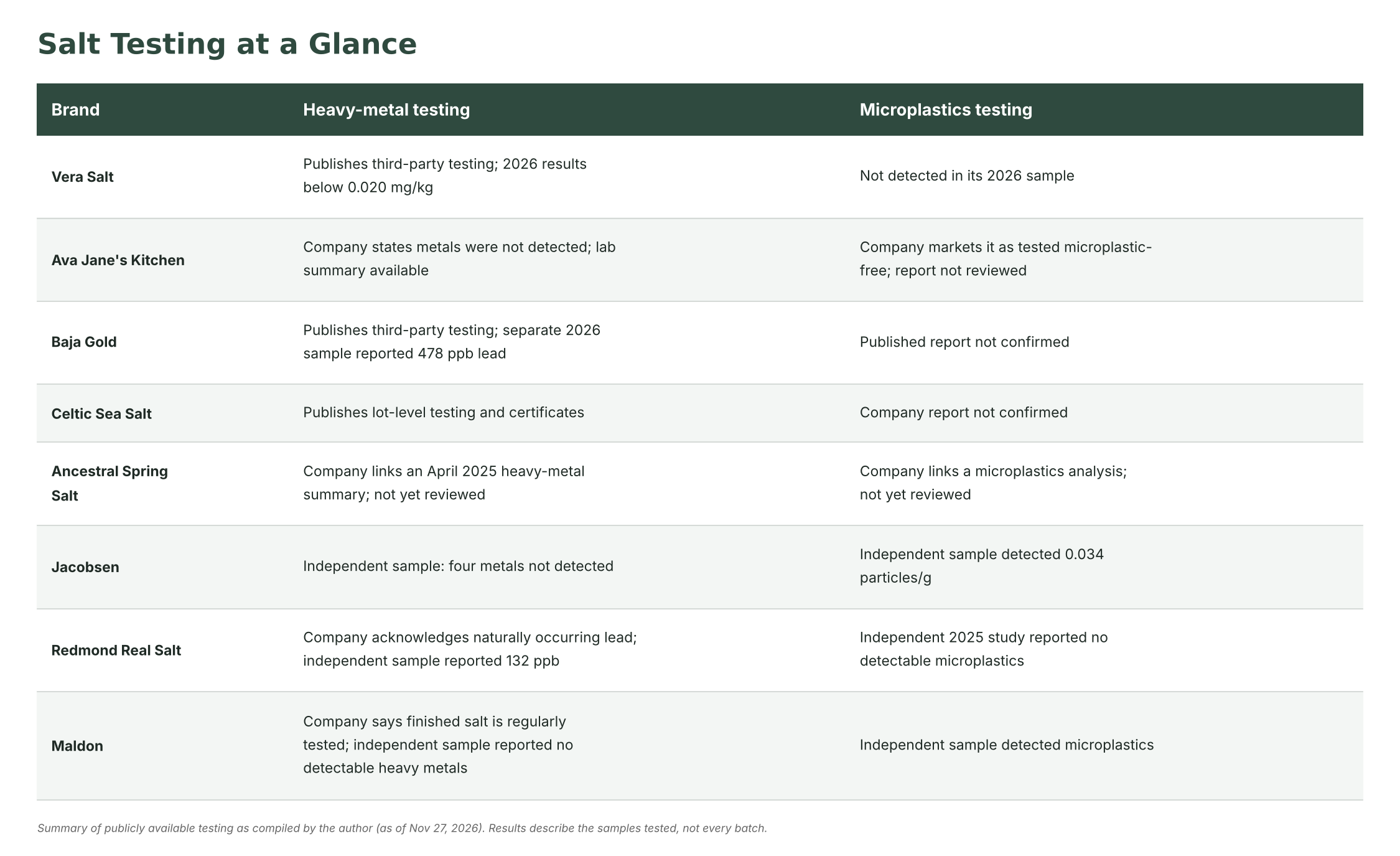
A few important notes:
Not detected doesn't mean absolute zero.
A company publishing a test is different from a company testing every production lot.
One sample doesn't necessarily represent every package or future batch.
Heavy-metal testing doesn't automatically include microplastics, pesticides or other contaminants.
Not finding a report doesn't prove a company doesn't test.
I'd much rather see companies publish actual reports, including methods and detection limits, than rely on words like pure or clean.
Do More Minerals Make a Better Salt?
This is where things get interesting, particularly if you're interested in mineral balance and nutrient density.
Different salts have different naturally occurring mineral profiles.
Some contain modest amounts of trace minerals, while others, particularly certain grey sea salts, contain more magnesium, calcium and potassium.
Vera has a relatively modest profile compared with some mineral-rich grey salts. Baja Gold and Celtic Sea Salt have different compositions, while Redmond has its own distinct profile because of its ancient underground origin.
Ancestral Spring Salt is another one I'm interested in exploring from this perspective. I want to understand more about its mineral composition and how that compares with other spring, sea and mined salts.
But here's something important:
A salt containing more minerals doesn't automatically make it a better source of minerals for your body.
We generally consume salt in relatively small quantities. Even a mineral-rich salt is unlikely to provide meaningful amounts of magnesium, potassium or calcium compared with the amounts we need from our overall diet.
I also don't want people to assume that simply switching to a mineral-rich salt will correct a mineral deficiency.
Mineral deficiency isn't always about what you eat.
Mineral status is influenced by much more than the mineral content of individual foods.
Potential contributors include:
Inadequate dietary intake.
Poor absorption in the digestive tract.
Digestive conditions that affect nutrient absorption.
Increased requirements during certain life stages.
Certain medications.
Excessive losses through sweat, urine or gastrointestinal issues.
Interactions between nutrients that influence absorption and utilization.
This is why I look at food quality and nutrient density as part of a much bigger picture.
A person can eat an otherwise nutrient-dense diet and still have issues with mineral status. Equally, someone might be consuming plenty of minerals but not absorbing or retaining them effectively.
It's not always as straightforward as adding more of something.
If you're experiencing symptoms, suspect a deficiency or want to understand your own nutritional needs, this is where individual assessment can be valuable.
This is also something we can explore in my consultations. Rather than guessing or randomly adding supplements, we can look more closely at your dietary patterns, food quality, nutritional intake and the bigger picture of your health.
If you'd like help understanding how to build a more nutrient-dense diet, you can also explore my Animal-Based Diet Guide, where I go into the foundations of eating and prioritizing nutrient-rich animal foods.
A Quick Note on Iodine: Does Your Salt Contain It?
I think iodine deserves its own mention because it's something that's easily overlooked when we start choosing specialty salts.
Most natural specialty salts, including many sea salts, mined salts and mineral-rich salts, are not iodized.
And this is important because iodine is an essential trace mineral that the body needs to produce thyroid hormones.
These hormones are involved in metabolism, growth and development.
Iodine is naturally found in certain foods, particularly seafood, fish, dairy and eggs, although the amounts vary depending on the food and its source.
Iodized salt is another established dietary source.
The important distinction is that a salt containing naturally occurring minerals isn't necessarily a salt containing meaningful amounts of iodine.
A beautiful grey salt, an ancient mined salt or a traditional spring salt shouldn't automatically be considered a source of iodine.
If you're moving away from conventional iodized table salt and using specialty salts exclusively, it's worth paying attention to where your iodine is coming from.
I don't think everyone needs to use iodized salt, but I do think it's important to make an informed decision rather than assume that natural mineral content covers all your nutritional needs.
And as always, more isn't necessarily better. Iodine requirements are individual, and excessive intake can also affect thyroid function.
It's Not Just the Salt Shaker: Where Else Is Salt Hiding?
Here's something I've become much more conscious of.
I don't just look at the salt I buy to sprinkle over my meals. I also think about the salt that's already coming into my diet through other foods.
For example, I buy unsalted butter.
Why? Because I want to have more control over the type of salt I'm adding to my food. I'd rather choose my own salt than have it already incorporated into an ingredient without giving it much thought.
It's a small example, but it reflects a bigger philosophy: I want to know what's going into my food, including the ingredients that are easy to overlook.
And salt can show up in quite a few places.
Some common examples include:
Butter: Salted butter already contains added salt, which is why I tend to buy unsalted.
Cheese: Many cheeses contain added salt, and the amount can vary considerably.
Jerky and biltong: These often contain salt as part of the curing and preservation process.
Bacon and cured meats: Salt is commonly used during curing.
Sausages: These can contain significant amounts of added sodium.
Bone broth and stock: Depending on the brand, these can contain added salt.
Canned fish: Sardines, tuna and other canned seafood may contain added salt.
Smoked fish: Salt is often part of the preparation and preservation process.
Sauces and condiments: Mustard, mayonnaise, dressings and other sauces can contribute to daily sodium intake.
Pickles and fermented foods: Salt is often essential to the fermentation or preservation process.
Seasoning blends: Some spice mixes contain quite a bit of added salt.
Packaged and convenience foods: Even foods that don't necessarily taste particularly salty can contain added sodium.
And of course, there's restaurant food and takeaway meals, where you may have very little control over how much salt has been used.
I'm not suggesting we need to eliminate all these foods. Many are perfectly reasonable parts of a nutrient-dense diet, and salt also plays an important role in food preparation, preservation and flavour.
I simply think it's useful to recognise the different sources.
If you're someone who deliberately adds salt to meals, uses electrolytes, exercises regularly or follows a carnivore or animal-based diet, it's worth considering the bigger picture rather than looking at the salt shaker in isolation.
For me, buying unsalted butter and other foods with “no added salt” is one small way of keeping that choice in my own hands.
It's not about being afraid of salt. It's about being intentional with it.
Why I Keep a Variety of Salts in My Kitchen
I don't feel the need to find one salt that does everything. Different salts have different textures, flavours, mineral profiles and uses. Some are great for everyday cooking, some make wonderful finishing salts with a delicate crunch, and others dissolve easily into food.
Rotating a few also feels like a sensible approach to me. It gives me a more well-rounded mix of minerals and means I'm not relying on a single source, especially since I haven't found the perfect salt.
My Salt Research Isn't Stopping Here
The brands I've mentioned in this article are just the beginning.
I already have a growing list of other salt producers from different parts of the world that I want to investigate. I'm interested in looking beyond the brands we're most familiar with and learning more about traditional salt harvesting, different geological sources and the people behind these products.
There are some fascinating producers out there, and I want to take the time to understand how they operate before drawing any conclusions.
My next step is to reach out, ask questions, request independent laboratory reports and, where possible, learn more about their harvesting and production processes firsthand.
I won't be sharing my entire research shortlist just yet. I'd rather do the groundwork first, speak with the producers and establish what I can actually verify.
As I work through this, I'll continue expanding this article and sharing the brands, findings and laboratory results that I think are worth discussing.
This is very much an ongoing project, and I suspect there will be quite a bit more to uncover.
My goal isn't to find a salt with the best marketing. It's to find producers who can genuinely stand behind what's in their product.
A Final Thought: It's Worth Knowing What's in Your Salt
I don't think we need to be afraid of salt.
I do think we're allowed to be curious about it.
We spend so much time thinking about the quality of our meat, dairy, eggs, vegetables and other foods, but salt is something we use almost every day. It deserves a little more attention.
For me, this is about going beyond the label.
I want to know where my salt comes from, how it's harvested, who produces it, what naturally occurs in it and what testing is being done to look for unwanted contaminants.
I also want to understand the bigger nutritional picture. Minerals, iodine and nutrient density all matter, but no single ingredient is going to solve everything.
We don't have to know everything before we start making more informed choices. We just have to be willing to ask better questions.