No Added Hormones
Hormone-Free, No Added Hormones, No rBST:
What Beef and Dairy Labels Really Mean
Because "hormone-free," "no rBST," and "raised without steroids" are not the same thing, and the differences matter when you're deciding where to spend your grocery dollars.
Walk down the meat aisle and you'll see a wall of claims: Hormone-Free. No Added Hormones. Raised Without Steroids. Natural. Grass-Fed. Head to the dairy case and you'll find rBST-Free and No Artificial Growth Hormones. They all sound reassuring, and they all sound similar.
They aren't. Some are precise, some are technically impossible, and some answer a completely different question than the one you're asking.
This guide breaks down what each label means, what it doesn't, how growth-promoting implants work, why milk and beef labels aren't interchangeable, and how to get answers the label can't give you.
The Quick Answer (For Skimmers)
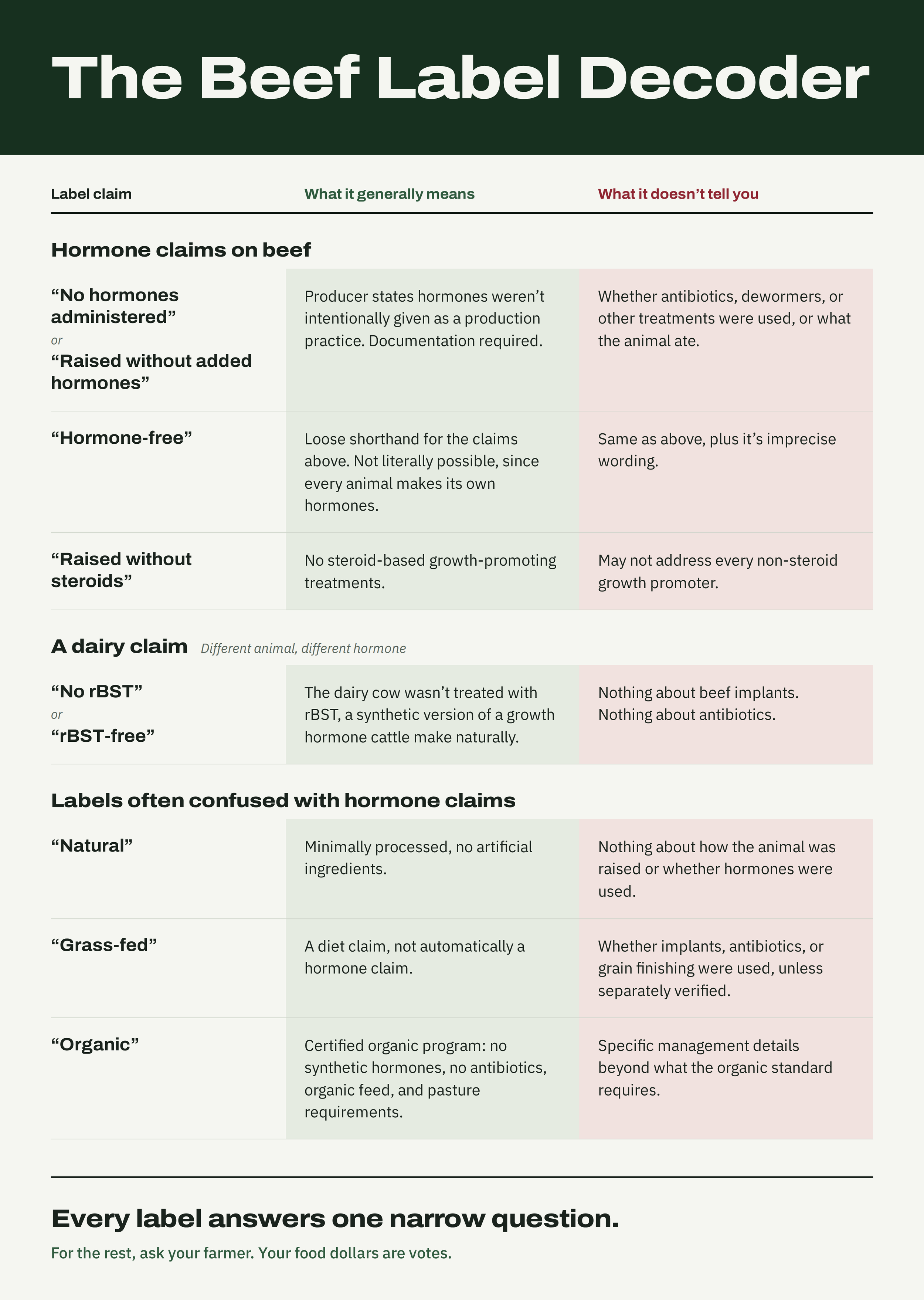
"Hormone-free" can't be literal. Every living animal produces hormones. On beef, USDA-approved wording is generally along the lines of "no hormones administered" or "raised without added hormones," backed by documentation.
"No added hormones" / "no hormones administered" means the producer didn't intentionally give the cattle hormones as a production practice. It does not mean the animal had zero hormones.
"Raised without steroids" means no steroid-based growth promoters were used. It doesn't necessarily cover every growth-promoting compound.
"No rBST" / "rBST-free" is a dairy claim about a milk-boosting growth hormone. It says nothing about beef implants.
None of these claims tell you whether antibiotics, vaccines, or dewormers were used. Those are separate categories.
If you’re like me and eat meat every day, this is the kind of information I think is worth knowing. We can spend a lot of time thinking about what we eat without necessarily knowing much about how it got to our plate.
This is also why I created my Animal-Based Diet Guide—a comprehensive resource for sourcing and eating quality animal foods.
Why "Hormone-Free" Is Biologically Impossible
Hormones are chemical messengers. They regulate growth, metabolism, reproduction, appetite, and stress response. Cattle produce estrogen, progesterone, and testosterone naturally, just like people, dogs, and every other mammal. So do the plants and animals.
That's why a living animal can't be "hormone-free," and why USDA doesn't approve that phrase as a literal claim on beef. For beef, approved language is generally along the lines of "no hormones administered" or "raised without added hormones." The producer must submit documentation showing that hormones weren't used in raising the animals. The claim is about what was given to the animal, not what the animal's body naturally makes.
If a package says "hormone-free," treat it as shorthand for "no added hormones," and check the fine print.
What Are Growth-Promoting Implants?
This is the part of the story many shoppers have never heard.
Some conventional beef cattle receive growth-promoting implants: small pellets placed under the skin on the back of the ear that release compounds slowly over time. Depending on the product and class of cattle, those compounds may include:
Estradiol (a natural estrogen)
Progesterone (a natural hormone)
Testosterone (a natural androgen)
Trenbolone acetate (a synthetic compound that mimics testosterone)
Zeranol (a non-steroidal compound with estrogen-like activity)
The FDA approves these implants for specific uses: to increase weight gain, improve feed efficiency, or both. For producers, that means cattle reach market weight faster on less feed. That's the economic incentive, and it's a large part of why implants are widespread in conventional beef production.
So when a label says "no hormones administered," it's telling you the answer to one specific question: were growth implants (and other added hormones) used? That's valuable information if it's what you want to know.
"Raised Without Steroids": Helpful, but Narrow
"Raised without steroids" is another production claim you'll see on beef. USDA recognizes this kind of animal-raising claim when it's properly substantiated.
The catch is in the wording. It addresses steroid compounds, and that includes some, but not all, of the substances that can be used as growth-promoting agents. Zeranol, for example, has estrogen-like activity but isn't technically a steroid. A label that only says "no steroids" leaves a small gap that "no hormones administered" is designed to close.
Consumers sometimes group in one more category: beta-agonist feed additives (such as ractopamine), which are used in some cattle to promote leanness and growth. These aren't hormones or steroids, and a "no hormones" label doesn't address them. If that matters to you, it's a question to ask the producer or look for on the label.
Bottom line: the more specific and well-documented the claim, the more it tells you. If you want the broadest coverage, look for "no hormones administered" or "raised without added hormones" and, if you can, confirm with the farmer.
rBST: Different Animal, Different Hormone
This is where many shoppers get tangled up.
rBST (recombinant bovine somatotropin) is a manufactured version of bST, a growth hormone cattle naturally produce. It's approved for use in dairy cows to increase milk production. It is not an implant, and it is not used in beef cattle the way implants are.
So:
"No rBST" or "rBST-free" means the cow wasn't treated with rBST.
It does not mean the cow had no hormones. Every cow makes bST naturally, along with many other hormones.
It is a dairy issue. It doesn't tell you anything about growth implants in beef. That's a separate topic.
Regulators have said that milk from rBST-treated and untreated cows is not significantly different. That's why you'll often see the claim accompanied by a small disclaimer saying so. Even so, many dairies and processors have moved away from rBST in response to consumer preference, so "rBST-free" is now widespread in the dairy case. It's a claim about a specific practice, not a broad statement about hormones or how the cow was raised.
The One Case Where "Hormone-Free" Is Always True
Here's a fun label fact: federal regulations prohibit the use of hormones in raising hogs and poultry. That means every chicken and every pork chop comes from an animal that wasn't given added hormones, so a "hormone-free chicken" label is technically true but tells you nothing about that brand versus the one next to it. When these claims appear on pork or poultry, they're generally required to carry a note explaining that federal rules prohibit hormone use anyway. If a brand of chicken is proudly advertising "no hormones," it's marketing a baseline, not a differentiator.
What These Labels Don't Tell You
Even the most precise hormone claim answers only one narrow question. It says nothing about:
Antibiotics. Antibiotic use is a separate claim category (look for wording like "raised without antibiotics," and note it requires its own documentation).
Vaccines. These are routine in conventional livestock practices.
Dewormers and parasite treatments. Another separate management category.
Diet. "No hormones" doesn't tell you whether cattle ate grass, grain, or a mix.
Finishing method. An animal can spend most of its life on pasture and be finished on grain, or vice versa.
Living conditions. Pasture access, stocking density, and animal welfare are separate topics.
A package can be accurate on hormones and silent on everything else. It's just how labels work. Each claim addresses one narrow question.
Is Implanted Beef Safe? A Fair Look at Both Sides
The regulatory position: The FDA approves steroid hormone implants for specific uses in beef cattle and considers meat from properly treated cattle safe to eat. The agency says its approvals are based on studies evaluating the safety of the animal, the edible tissues, and the environment, and it establishes acceptable levels of hormone residues in meat. Some approved implants use hormones that also occur naturally in cattle and humans, while others use synthetic compounds.
The other side: Some consumers, researchers, and regulators take a more precautionary approach. The European Union has prohibited the use of hormones for growth promotion in farm animals for decades and also prohibits imports of meat from animals treated with growth-promoting hormones. Its position is based on its own assessment of the potential risks associated with hormone residues.
There are also questions beyond human food safety, including what happens to these compounds and their metabolites after they leave the animal and enter the environment. And then there’s a bigger philosophical question: do you want your food production system to rely on growth-promoting hormones in the first place?
I’ve also recently come across documentation of male cattle showing lactation-related abnormalities at slaughter, which made me curious about whether exogenous hormones or other factors could play a role. That connection has not been established, so I don’t want to present it as a fact, but I do think it’s a reasonable area to ask questions about and learn more about.
You don’t have to settle the entire debate to make a decision about what you buy. Plenty of people choose “no hormones administered” beef simply because they prefer it, because it fits how they want their food raised, or because they want to minimize their exposure to added compounds where they can. That’s a perfectly reasonable reason to read labels.
It’s your food, and you’re entitled to buy according to your own values and comfort level.
Related Labels That Get Confused With Hormone Claims
"Natural." Under USDA rules, this generally means minimally processed with no artificial ingredients. It says nothing about how the animal was raised and doesn't guarantee no hormones.
"Grass-fed." This is about diet. A grass-fed label doesn't automatically mean no implants or no antibiotics unless the product also carries those claims or a third-party certification that covers them. Look for wording like "100% grass-fed" and a verification program if this matters to you.
"Organic." USDA Certified Organic livestock standards prohibit synthetic growth hormones and routine antibiotics, require organic feed, and include pasture requirements. It's one of the more comprehensive labels, and it's independently certified.
Third-party certifications (such as Certified Humane, Global Animal Partnership, or American Grassfed Association) involve audits and defined standards, which can give a claim more weight than a self-reported one. Check what each program actually covers.
What to Look For on the Label
If your goal is to know whether your beef came from cattle that were not given growth-promoting hormone treatments, look for:
No hormones administered
Raised without added hormones
Raised without steroids (helpful, but narrower)
Then remember that the claim is only as good as the documentation behind it, and no label can tell you everything.
Want to Go Deeper?
If you’re trying to build your diet around quality animal foods but aren’t sure where to start, I put together my Animal-Based Diet Guide. It covers how to build an animal-based diet, what foods to prioritize, how to source quality meat and dairy, and practical resources to make it easier.
Questions to Ask Your Farmer
If you want to know more than a label can tell you, ask. A farmer who's proud of their practices will usually be glad you did. Here are the questions worth asking, and why each one matters:
Were they implanted? This is the most direct way to ask about growth-promoting hormones.
What did they eat? Pasture, hay, grain, or a combination? This affects flavor, fat composition, and how the animal lived.
Were they finished on grass or grain? "Finishing" is the last stretch before harvest and has a big impact on the final product.
Were they raised entirely on pasture? This tells you about their living conditions, not just their diet.
Were they dairy-cross or native beef cattle? Breed and genetics influence growth, marbling, and the type of program the animal was raised in.
What medications or other treatments were used? This covers antibiotics, dewormers, and anything else, including how they're handled when an animal gets sick.
You can also ask how long they've farmed, how the animals are handled, where they're processed, and whether you can visit the farm. Transparency is a good sign.
I also have farms I know and trust on my favorites page that you can check out! Some ship straight to your door, or you can use them to learn more about their practices and find similar farms local to you.
A Simple Label-Reading Checklist
Next time you're at the store, run through this:
Read the exact wording. "No hormones administered" is more precise than "hormone-free."
Check what species it is. "No hormones" on chicken or pork is a baseline, not a bonus.
Look for a second claim. If antibiotics, feed, or finishing matter to you, look for separate claims.
Look for third-party verification. Independent audits add credibility.
When in doubt, ask. The butcher, the brand, or the farmer can often tell you more.
Why Knowing Your Farmer Is the Best "Label"
I'm increasingly convinced that knowing your farmer is one of the most valuable "labels" you can have. A package can only fit so much text, and every claim answers just one narrow question. A conversation can answer all of them. When you know who raised your food and how, you don't have to decode the fine print. You can just ask.
Your food dollars are votes. Every time you buy, you're supporting a way of raising animals, a way of using land, and a kind of business. Spend them accordingly.
Final Takeaways
"Hormone-free" is a marketing shorthand, not a scientific fact.
"No hormones administered" and "raised without added hormones" are the most useful beef claims for avoiding growth implants.
"Raised without steroids" is helpful but narrower.
"No rBST" is about dairy, not beef.
No hormone label tells you about antibiotics, vaccines, feed, or living conditions.
The best source of information is often the person who raised the animal.