Fasting with Intention
Fasting: Creating Space for Healing, Not Control
My recent five-day experience with fasting didn’t begin as a goal or a protocol—it began as a response.
A month ago, I suffered a major back injury that, even now, prevents me from doing many everyday tasks. It has been debilitating and deeply frustrating (though back injuries are never easy). The injury happened while deadlifting heavy weight—not riding horses—though ironically, I had plans to begin learning how to ride shortly afterward.
Those plans continued despite the pain. I have an African horseback safari coming up at the end of February, and I need to develop riding skills quickly. During this injury phase, my body wasn’t asking for its usual rhythm of meals; it was asking for rest. Instead of overriding that signal, I chose to listen.
Around the same time, the fast coincided with my menstrual cycle, and my appetite naturally declined. It felt like a clear invitation to turn inward.
My Fast & Experience with Fasting
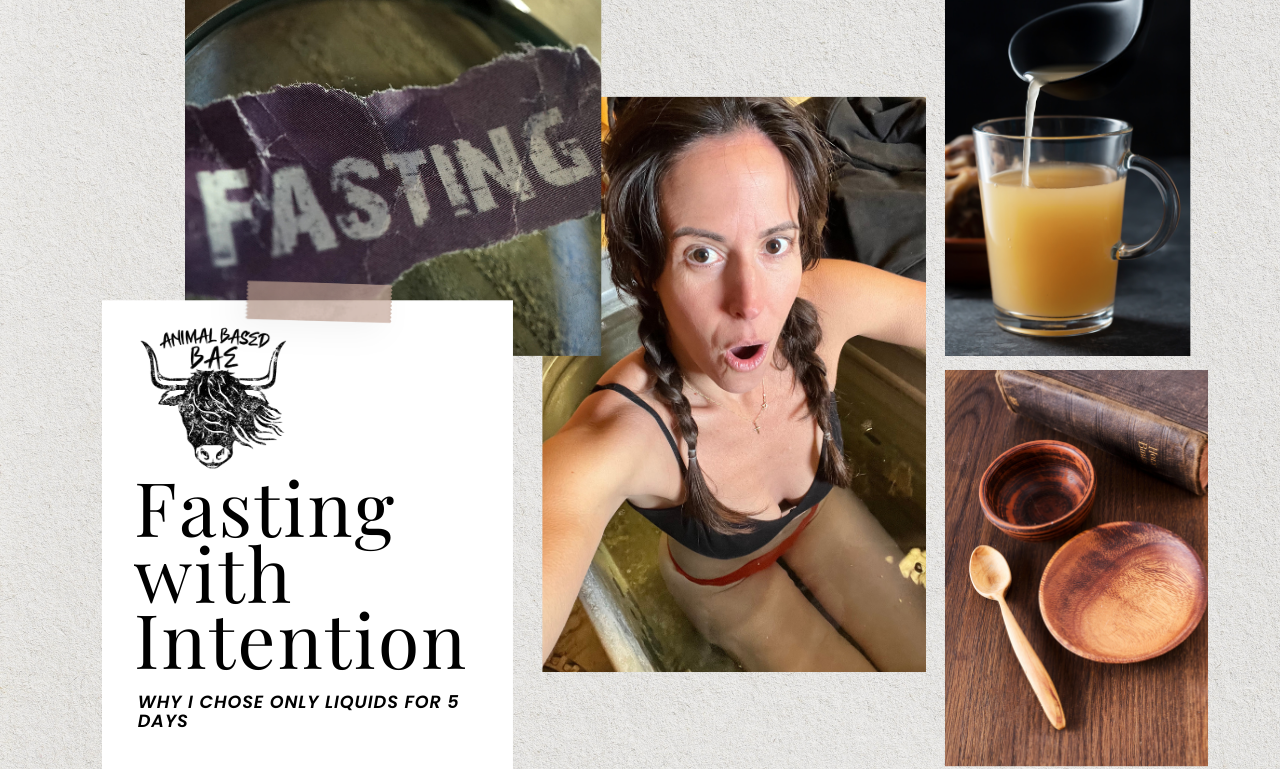
I’ve practiced different types of fasts before—including seven days of only water, bone broth fasts, and even milk-only fasts. Each time, I’ve learned to honor what my body is asking for rather than forcing a specific approach. For this period, I chose a modified fast—not to restrict, but to support healing and honor my cycle. I focused on gentle nourishment that required minimal digestion: mostly bone broth, occasionally raw milk, and water. I also included a healing support shot—something some might label “anti-inflammatory,” though I personally resist that framing. It was a simple blend of turmeric, lemon, and ginger, used to support the healing process rather than to “fight” anything (I explore this more deeply in my other blog, Why Chasing Inflammation Is the Wrong Goal).
The intention was simple: to conserve energy, support balance, and allow my body to prioritize repair without additional stress.
This experience arrived at exactly the right time. It offered my body and mind a sacred space to rest, release, and heal. I could feel myself getting stronger, even amid the frustration of not being able to do simple things, like bending down to pick something up—or performing at the physical level needed to learn horseback riding.
As a side note, horses are incredible healers. Being around them lifted my spirits during this time in a way that felt deeply supportive. I was also learning to ride, which can be counterproductive when healing a back injury due to the physical impact involved. That said, I’m fully aware that certain commitments required me to engage my body when it likely needed more rest. There is always cause and effect, and while healing may have happened more quickly without those obligations, awareness itself is part of the process.
This practice wasn’t about discipline or deprivation—it was about intention, presence, and deep listening. By stepping away from the constant cycle of preparing, eating, and digesting food, I was able to tune in to the subtle whispers of my body and soul. I met my pain with awareness, honored it, and allowed healing to unfold naturally—meeting my body exactly where it was.
From this place of stillness, clarity emerged. I began to understand what my body truly needed in order to heal, where the pain was originating, and how to move forward with intention. Carrying this awareness into the next phase of physical healing felt intuitive and supportive, and I am deeply grateful to have honored this opportunity to meet my body with such presence and care.
What Fasting Really Is (and Isn’t)
Fasting is often misunderstood as control. In practice, it can be about creating space—in the body, the mind, and the day. Space to notice hunger and fullness, yes, but also emotions, habits, and signals we often override when eating is constant or automatic.
Across cultures and healing traditions, fasting has been used not only for physical repair, but for mental clarity, spiritual presence, and intentional reflection. Its effects extend well beyond digestion.
Importantly, fasting is not one thing. There are many forms, each with different intentions and levels of intensity. What’s supportive for one person—or one season—may be inappropriate in another.
This is not medical advice. Context matters.
Why People Fast
People may choose fasting to:
Give the digestive system a break
Support metabolic flexibility and insulin sensitivity
Encourage cellular repair and autophagy
Reduce inflammation
Improve focus and mental clarity
Break habitual or emotional eating patterns
Create space for reflection, prayer, or journaling
Reconnect with hunger, intuition, and bodily cues
More is not always better. Timing, duration, and individual capacity are everything.
A Brief Look at the Physiology
Short-term fasting can initiate several well-documented processes:
Reduced digestive workload, freeing energy for repair
Temporary improvements in insulin sensitivity
Activation of autophagy, the body’s cellular “cleanup” system
Hormonal shifts that can increase alertness and focus
In some cases, short-term fat utilization that may lead to temporary weight changes
These effects depend heavily on duration, nervous system state, hormonal balance, and nourishment before and after the fast. While some people experience weight loss, it is often a byproduct rather than the primary benefit.
Chronic restriction, excessive fasting, or poorly timed fasts—especially without adequate refeeding—can be counterproductive and increase stress rather than support healing.
The Mental & Spiritual Dimension
When food is simplified or temporarily removed, many people notice:
Fewer daily distractions
Heightened awareness of thoughts and emotions
Clearer observation of habits
More time and mental space
Fasting can gently reveal why we eat—not just when we’re hungry, but when we’re bored, stressed, or seeking comfort. That awareness alone can be transformative.
Types of Fasting & What to Know
There are many ways people approach fasting, each with different intentions, benefits, and levels of intensity. No single method is universally “better”—the right approach depends on context, health, stress levels, and what the body is asking for.
Common Types of Fasting (Brief Overview)
Water Fasting
Only water is consumed for a set period. This approach offers maximal digestive rest and is often used to enter deep ketosis and support cellular repair. It can be physically and mentally demanding and is not appropriate for everyone.
Bone Broth Fasting
Includes mineral-rich broth while avoiding solid food. This is often used during recovery, injury, or periods of depletion. It is supportive rather than depleting and still allows for reduced digestive load.
Liquid Fasting
Calories are consumed through broths, juices, smoothies, or teas. This approach is more flexible, though quality, balance, and intention matter greatly.
Milk Fasting
Uses milk as the primary source of nourishment. This method is less about restriction and more about simplification and steadiness, offering calories while minimizing digestive complexity.
Dry Fasting
Abstaining from both food and water. This is highly extreme and generally not recommended for health or healing purposes.
Each of these approaches carries different risks and benefits, and none are meant to be practiced indefinitely.
Common Questions About Fasting
Does fasting help with weight loss?
Fasting can support weight loss for some people, but weight loss should not be the primary goal. When practiced intentionally, fasting may help regulate appetite, improve metabolic flexibility, and reduce mindless eating. That said, weight changes are highly individual and influenced by hormones, stress levels, sleep quality, nervous system state, and overall nourishment.
When fasting is used solely for weight loss—especially without adequate refeeding—it can backfire, increasing stress and creating further imbalance rather than healing.
Some people pursue water fasting specifically to enter deep ketosis, give the digestive system complete rest, and support cellular repair. In this context, the goal is not weight loss, but metabolic and cellular reset—shifting the body fully into fat-burning and repair modes, which requires no caloric intake.
What can you have on a water fast?
If you are doing a true water fast for deep ketosis and maximal metabolic effects, the answer is very simple:
Still water only.
That means:
No calories
No bone broth
No teas
No lemon, salt, or sweeteners
No supplements (unless medically necessary)
And yes—not even sparkling water
Anything with calories, flavoring, or stimulants signals digestion and interrupts the full fasting state.
Why is a water fast so strict?
A water fast is designed to remove all external inputs so the body can redirect energy toward:
Ketosis
Autophagy (cellular cleanup)
Nervous system downregulation
Metabolic rest
Even small additions can shift the body out of this state.
Is water fasting necessary?
No. Water fasting is not required for healing, and it is not appropriate for everyone—especially during periods of high stress, injury recovery, or hormonal sensitivity. Many people experience profound benefits from modified fasts that still support the body with gentle nourishment.
What can I drink or eat during a modified fast?
This depends on the type of fast and the intention behind it. During a supportive or modified fast, gentle nourishment may include:
Water (still or mineral)
Bone broth
Herbal teas
Electrolytes (if needed)
Small amounts of easily digestible liquids, such as raw milk (for those who tolerate it)
IV or hydration drips
The goal is not deprivation, but reducing digestive demand while still meeting the body’s needs.
Does fasting slow metabolism?
Short-term fasting does not inherently slow metabolism and may temporarily increase certain metabolic hormones. However, context matters.
Chronic restriction can reduce metabolic rate
Long fasts without proper refeeding can increase stress
Hormones, sleep, and nervous system state all play a role
Fasting works best when it is cyclical, intentional, and supportive—not constant.
Is fasting safe for women?
Fasting can be supportive for women when aligned with hormonal cycles and practiced with intention. Appetite naturally fluctuates throughout the cycle, and honoring those shifts—rather than overriding them—can support hormonal balance. Extended or rigid fasting during high-stress phases may be counterproductive, especially when the body is asking for nourishment or rest.
Can fasting help with inflammation?
Rather than “fighting inflammation,” fasting may help create the conditions for balance and recovery by reducing digestive demand and allowing the body to redirect energy toward repair. The goal is not suppression, but listening to what the body needs in the moment.
How long should a fast be?
There is no one-size-fits-all answer. Some people benefit from short fasting windows, while others find longer fasts supportive during specific phases of healing or rest. Duration should be guided by energy levels, stress, cycle phase, and overall health—not by rules, trends, or external pressure.
Final Thoughts: Fasting as Support, Not Stress
When fasting becomes rigid, it can create harm. When it is flexible, responsive, and rooted in listening, it can support healing—physically, mentally, and spiritually.
Sometimes fasting is about food.
Often, it’s about attention.
What we remove creates space for what we begin to notice.
This is not meant to be a comprehensive guide to fasting, but rather an invitation—to reflect on what type of fast, if any, might support you, and to explore further with curiosity and discernment. During my fasting phase, I also incorporated peptides, ivermectin and other healing modalities that aligned with my goal of supporting a faster recovery from a back injury.
There are many resources available for deeper exploration, including research-based voices like Andrew Huberman for those interested in more structured, protocol-driven perspectives on fasting. This episode offers a thorough yet practical breakdown of how fasting and time-restricted eating affect fat loss, metabolism, hormones, mental clarity, muscle preservation, and long-term health. It also clarifies what truly counts as being “fasted,” what actually breaks a fast, and how to tailor fasting windows to your individual biology rather than relying on one-size-fits-all rules.