Losing Weight on an Animal-Based Diet:
Why You’re Stuck and How to Fix It
The animal-based lifestyle—centered around high-quality meat, organs, fruit, honey, and raw dairy—can be a game changer. If you’ve transitioned from a standard Western diet filled with seed oils and ultra-processed foods, you’ve probably already felt the benefits: reduced inflammation, steadier energy, and that initial “whoosh” of weight loss.
But what happens when the scale stops moving—or even starts creeping back up?
If you feel like you’re “doing everything right” but can’t seem to lose those last 10–15 pounds, you’re not alone. A common mistake is treating energy-dense foods like butter, fatty cuts of meat, and honey as if they come without consequences. While these foods can be incredibly nutritious, they still contribute calories. Reaching a lean, athletic physique requires moving beyond the basics and paying attention to the finer details of fat loss on an animal-based diet.
Why the Scale Lies
Before diving in, keep this in mind: the scale is a blunt tool. It can’t distinguish between water retention, muscle gain, and fat loss. If you’re strength training, you may be getting leaner even if your weight stays the same. Instead, pay attention to the mirror, how your clothes fit, and your performance in the gym.
Here are the top three reasons you might not be getting lean and how to fix them:
1. Ratios Matter: Knowledge Is Power
I’m not suggesting you become obsessive with a calculator, but data is your best friend. Foods like honey and ribeye are incredibly nutrient-dense, but they’re also energy-dense. We measure food for our pets to keep them healthy—why wouldn’t we do the same for ourselves?
Weighing your food isn’t punishment; it’s maintenance for your engine. It gives you honest feedback. That “tablespoon” of honey? It might actually be three and that adds up quickly.
The Fix:
If the scale isn’t moving—or you’re not reaching your body composition goals—pull out a food scale for two weeks. Think of this as a short-term awareness phase, not a lifelong rule.
Start by tracking what you’re already eating for about a week. Don’t try to change anything yet. This removes the pressure of making adjustments and lets you simply build the habit of weighing and logging your food. Once you have that baseline, you can begin making intentional changes.
Use a simple kitchen scale (nothing fancy needed) and a tracking app like Cronometer. Even the free version gives you useful insight into both macros and some micronutrients.
How to Start:
Weigh your protein first. For example, measure ½ lb of chicken breast raw to establish a baseline (you can refine cooked weights later if needed).
Then track everything else: fruit, squash, yogurt, etc.
Don’t forget the extras—if you add butter to a pan or drizzle honey in your coffee, it counts.
Think of this like budgeting your money. You’re not restricting—you’re allocating.
If tracking brings up unhealthy thoughts or behaviors around food (such as a history of disordered eating), it’s important to prioritize your relationship with food first and seek support from a qualified professional.
Once you’ve been consistently tracking, take a step back and look at the patterns. In your tracking app, set a realistic goal weight—but remember, the scale reflects everything, not just fat. Instead of chasing an old number, think in terms of body recomposition.
Let’s dig deeper into why muscle matters, how it supports your metabolism, and how to create a sustainable deficit without negatively impacting your hormones.
2. Build the “Metabolic Furnace”
If two people weigh 150 lbs and eat the exact same meals, the one with more muscle mass will burn fat more efficiently. Muscle is metabolically “expensive”—it requires energy just to exist.
So instead of focusing only on “losing weight,” shift your mindset to building the furnace that burns it.
Prioritize Resistance Training:
In an ideal scenario, you’re lifting weights 4–5 times per week. If that feels like too much, start where you are. Even adding one session per week is progress. What matters most is consistency—showing up regularly will outperform short bursts of perfection every time. And if you want this to be sustainable, it has to fit your life.
Hit Your Protein Goal:
Muscle is stimulated in the gym, but it’s built and repaired with protein. A solid baseline is about 1 gram of protein per pound of target body weight. Many people actually benefit from going higher—closer to 1.2–1.5g per pound—so don’t undershoot.
Establish a Routine:
Habits take time to build. Give yourself a few weeks to lock in a rhythm. Even 15 minutes of intentional movement daily can make a difference—especially if it involves resistance or muscle activation (we’ll talk about cardio next). This consistent signal tells your body to maintain and build muscle, which helps keep your metabolism running strong.
3. Close the Ancestral Movement Gap
Our ancestors didn’t “schedule” workouts—their entire lives were built around movement. They weren’t sitting at desks for eight hours under fluorescent lights or relying on delivery apps that kept them glued to a chair. Movement was constant and natural.
That’s also why many traditional cultures can thrive on higher-carb diets—their daily lives include steady, low-level activity. Modern life, especially in places like the U.S., has made it incredibly easy to do everything from a screen with minimal effort. That convenience comes at a cost and changing it requires intentional action.
The challenge is real. Most of us work on laptops and live in environments that don’t naturally support movement. So we have to create it. Sometimes that means multitasking. Sometimes it means making bigger lifestyle shifts. Either way, it doesn’t happen by accident.
For example, I lift weights five days a week, do high-intensity workouts once or twice a week, and walk daily. I also stay active in ways that are functional and enjoyable—hiking, kayaking, volleyball, anything outdoors. I choose movement over defaulting to screens and TV—not because those are “bad,” but because daily activity adds up.
It doesn’t have to be extreme. Start by being more intentional:
Get up and down more throughout the day
Take phone calls while walking outside
Clean your house or garden with energy and purpose
Dance, stretch, move—whatever keeps your body engaged
Make it a goal to get outside as often as you can. The key isn’t perfection—it’s consistency. Your body is designed to move, and the more you honor that, the better it will perform.
Non-Negotiable: Walk Every Single Day
The goal is around 10,000 steps per day, but if walking isn’t even a habit yet, start smaller. Begin with something simple and repeatable:
5 minutes in the morning, 5 minutes midday, and 5 minutes after dinner.
That alone builds consistency and it also gets you outside at key times of day, which supports your circadian rhythm, digestion, and overall health (more on sleep and light exposure later).
Walking right after meals is especially powerful. It helps shuttle glucose out of the bloodstream and into your muscles, which can support blood sugar control. It can also help regulate appetite—many people notice they feel less “snacky” when they move after eating.
What This Can Look Like (Example Routine):
This is just one example—not a prescription.
I personally train fasted (not necessary for everyone), then eat breakfast around 9:30am. After that, I go for about an hour walk with my dog. I start my day early—usually working by 5 a.m., training around 8, then getting back to work after my walk.
Later in the day, I’ll take another movement break or walk in the afternoon, eat dinner around 4:30pm, and finish with a 30-minute evening walk. My job also keeps me fairly active, so there’s movement built in throughout the day.
Your schedule may look completely different and that’s fine. The point isn’t to copy this exactly, but to find ways to consistently layer movement into your day.
The “Big Eater” Strategy: Smart Volume
If you love big portions, you don’t have to fight that—you just have to get smarter about energy in vs. energy out. The goal is to stay full and satisfied while still maintaining a deficit.
Here’s how to do it:
Choose Leaner Proteins:
Swap higher-fat cuts (like 80/20 beef) for leaner options such as 90/10 or even up to 99% beef, bison, elk, or chicken breast. You’ll be able to eat a larger volume of food for fewer calories while increasing your protein intake.
Pro tip: Always check labels. Ground chicken, for example, often includes skin and added fat, which changes the macros significantly compared to chicken breast.
The Egg Hack:
Use egg whites to boost volume and protein, but keep 1–2 yolks for essential nutrients. You can save the extra yolks for other uses—like adding to recipes, making sauces, or curing them in salt or honey for later. I even use them for a hair mask!
Volume Fillers:
Squash is an underrated “cheat code.” You can eat a large amount and feel full without dramatically increasing calories.
If you tolerate it, rice can also be a useful addition for energy and satiety. Fruits like apples and berries are great as well—just be mindful of portions and track them like anything else.
Grill More (or Cook Smarter):
Grilling allows excess fat to drip away, while pan-frying in butter or tallow can quietly add a lot of extra calories.
No grill? No problem. You can cook in the oven or on the stovetop using water or bone broth to reduce added fats.
Don’t Fear Fat—But Manage It:
Fat is essential for hormone health, but during a fat-loss phase, it needs to be controlled. Keeping fat intake around ~50g per day (for a short-term cut) can help maintain balance while still creating a deficit.
Be Mindful with Carbs (Fruit, Honey, Maple):
These can absolutely fit into an animal-based approach, but portions matter. Use a tracking tool to understand how they fit into your daily intake.
Dairy Strategy:
Opt for non-fat or reduced-fat dairy to significantly lower calories while still getting the benefits.
Non-fat yogurt and skim or low-fat milk are great tools
Reduced fat cottage cheese can be an easy, high-protein option
Harder cheeses like parmesan or Swiss tend to be higher in protein and lower in calories compared to creamier cheeses
Again, it’s about choosing where you want to “spend” your calories.
If You Don’t Love Volume:
You can still hit your protein goals with lower-volume options like protein shakes, collagen, or convenient high-protein snacks. These make it easier to stay on track without constantly eating large meals.
Note: I’ll drop my favorite sources below so you can grab these foods easily without having to navigate all the options yourself.
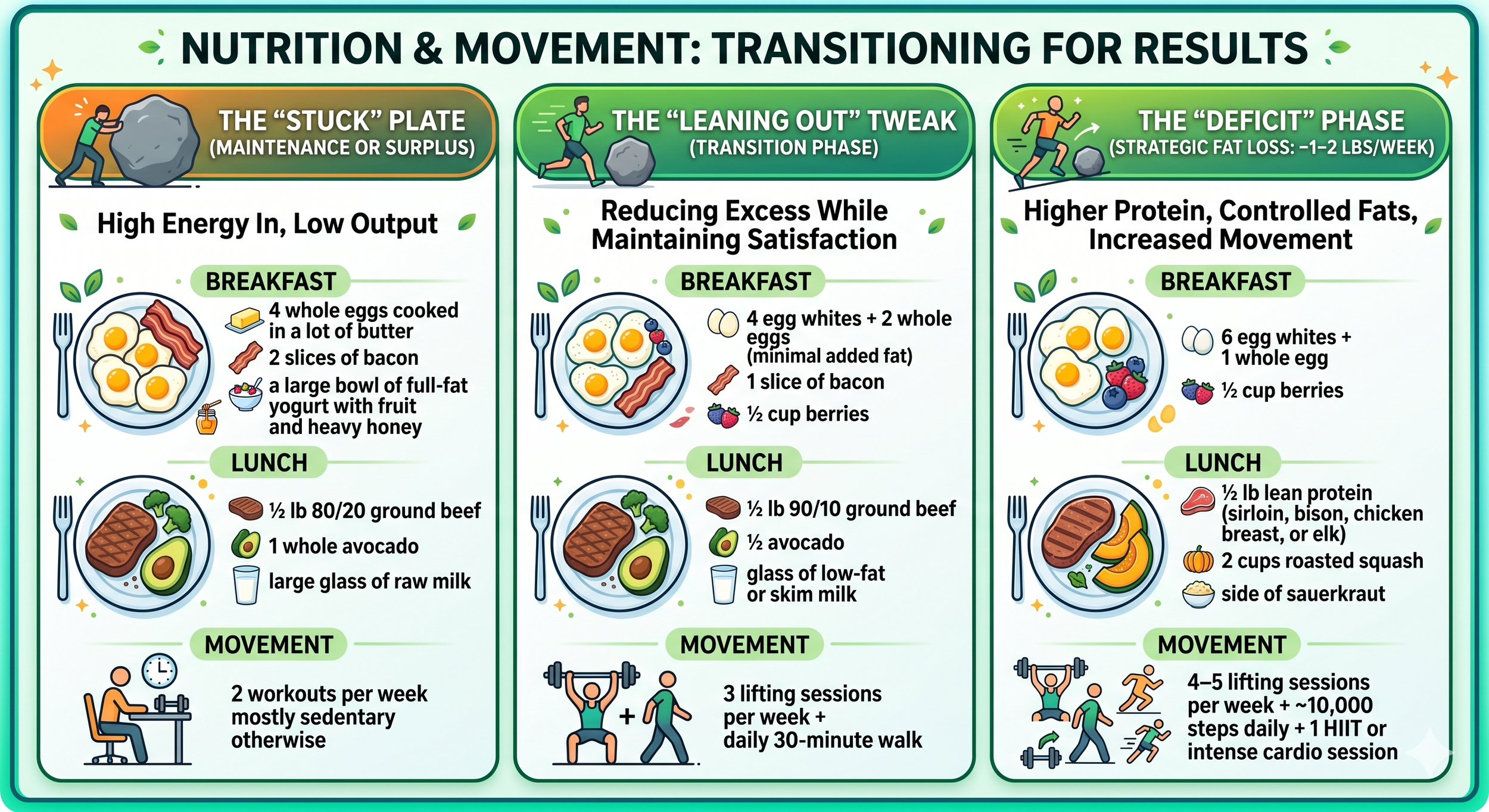
The Tweak Guide: From “Stuck” to “Leaning Out”
This is a general example to help you understand why weight loss can stall, where hidden calories creep in, and what it actually looks like to make adjustments.
You’ll need to tailor this to your own goals, but these are very common patterns I see in people who feel “stuck.” And to be clear: all of these foods can be healthy. The difference here isn’t health—it’s energy balance and body composition.
There are plenty of other ways to structure this, but the goal here is to show where things often go unnoticed—especially how quickly calories add up from fats, dairy, and “extras.”
Weighing and tracking your food will make this very clear. You’ll start to see the difference between a surplus, maintenance, and a deficit—not just in theory, but in your actual daily habits. Make sure you understand your baseline (BMR) and how your intake aligns with your goals.
A Quick Note on Meal Timing & Frequency
Before overcomplicating things, focus first on food quality and quantity.
That said, it’s helpful to understand this: every time you eat, blood glucose rises. While elevated, your body is less likely to tap into stored fat for energy. If you’re constantly eating or snacking, you may be spending more time in a “fed” state and less time in a “fat-burning” state.
For that reason, I personally prefer two meals per day and avoid snacking, but that’s not a requirement. The key takeaway is awareness.
More frequent eating = more frequent glucose spikes
Larger spikes can take longer to come back down
Fat loss happens more efficiently when levels return to baseline
This doesn’t mean you should fear carbs, fruit, or glucose spikes—it just means you should understand how your eating patterns influence energy use.
Don’t Overlook This: Sleep Is Foundational
If there’s one thing people underestimate, it’s sleep.
Quality sleep drives everything—your energy, hunger signals, stress levels, and how your body uses or stores energy. Poor sleep can signal your body to hold onto fat, increase cravings, and reduce performance.
Dialing in your sleep can improve:
Hunger and satiety regulation
Inflammation and recovery
Hormonal balance
Daily energy and consistency
If everything else feels “on point” but progress is stalled, sleep is often the missing piece.
Optimizing the Environment: Sunlight & Sleep
A calorie deficit is only part of the equation. If your cortisol (stress hormone) is chronically elevated and your sleep is poor, your body will resist fat loss and hold onto energy more tightly.
This is why environment matters just as much as diet and exercise.
Sunlight Stacking:
Get 2–5 minutes of morning sunlight as early as possible to help set your circadian rhythm. If you can, try to:
Eat lunch outside for ~10 minutes
Take a short walk around sunset
These simple habits help anchor your internal clock, improve energy regulation, and support better sleep later that night.
The Blue Light Trap:
Bright artificial light and screens at night signal “daytime” to your brain, which can suppress melatonin and increase cortisol.
To support better sleep:
Use blue light blockers in the evening
Switch to warm or red lighting at night
I personally use red light bulbs from brands like Bon Charge (code: BAE15) and treat this as a non-negotiable. The impact on sleep quality and recovery is significant, and it only becomes more important over time.
Sleep Killers to Avoid:
A few simple habits can make or break sleep quality:
Eating large meals too close to bedtime
Alcohol before sleep
Excessive fluid intake right before bed (can disrupt sleep with nighttime wake-ups)
Deep, uninterrupted sleep is where recovery and fat loss actually happen. If sleep is disrupted, everything else becomes harder.
Common Questions (and What to Know)
You might have questions like: “Why do I wake up hungry?” or “Why do I wake up to use the bathroom?” These are common, but they can’t all be fully addressed in this section. I’ll go deeper into sleep troubleshooting in a separate, more detailed guide.
For now, understand this: most sleep issues are multifactorial and often tied to stress, timing of food and fluids, and overall routine—not just one single cause.
Nutrition & Sleep Support
A well-structured whole-food animal based diet usually covers most nutrients needed for good sleep. However, some people may still fall short in key areas like magnesium.
If needed, magnesium supplementation can support relaxation and sleep quality. A reputable option is from Perfect Supplements (code: BAE10).
That said, food should always come first. Focus on nutrient-dense meals before relying on supplements.
The Game Plan
Don’t stay in a deficit forever. Instead, think in phases:
Phase 1: Build Consistency
Get consistent with food and movement first. Start tracking without obsessing over macros, and build the habit of daily walking.
Focus here is simple:
Establish routine
Clean up food choices
Build awareness around how much you’re actually eating
No perfection—just consistency.
Phase 2: Build the “Muscle Furnace”
Shift your focus toward protein and strength training.
Prioritize high-protein meals
Choose lower-calorie, higher-volume foods to stay full and satisfied
Train consistently to build lean muscle
This phase is about building structure, not restricting hard.
Phase 3: Strategic Fat Loss Phase (6–8 weeks)
Once consistency and muscle-building habits are in place, enter a temporary calorie deficit to lean out. This is where the actual fat loss happens, but it’s only effective if the foundation is already built.
After reaching your goal, move back into maintenance so you can increase variety, flexibility, and enjoyment without rebound.
Keep It Simple (This Matters More Than You Think)
One of the biggest mistakes people make is overcomplicating everything—constantly changing recipes, workouts, and routines.
For a short period of time, be “boring.” Because boring is repeatable—and repeatable is what gets results.
Build simple meals using:
Protein
Carbs
Fat
Basic seasonings (add sauces if you want—just account for them)
Meal prep the same core meals. Eat them consistently. Remove daily decision fatigue.
The same applies to training:
Stick to a consistent weekly structure
Train different muscle groups, but follow the same routine
Focus on showing up, not constantly changing the plan
If you’re new, consistency will outperform optimization every single time.
Resources
Below are some of my go-to sources for high-quality, nutrient-dense, and macro-friendly foods and supplements. These focus on clean proteins, low-fat dairy, convenient options, and foundational health support.
Top Favorite for Clean Meats, Proteins & Low-Fat Dairy
High-quality, minimally processed animal foods sourced from well-raised animals.
Northstar Bison – Grass-fed, pasture-raised bison, elk, and other regenerative meats. Use for: lean protein options, variety meats, and high-quality red meat sources. (use code: BAE10)
Triple E Farm – Regenerative, farm-direct animal products including low-fat dairy, corn and soy free eggs, chicken, and more. Use for: clean dairy, meats, eggs, and farm-sourced staples you can trust. (use code: BAE25)
Low-Fat Dairy Options (Category Guide) helpful for lowering overall calories while maintaining protein intake: Skim milk and reduced fat cottage cheese, lean, high-protein cheeses (swiss)
Convenient Protein & Macro-Friendly Foods
Easy-to-use options for hitting protein goals without complicated prep.
Lineage Provisions– Protein powders, collagen, protein bars, meat sticks, and other convenient high-protein foods. Use for: quick protein intake, shakes, snacks, and on-the-go nutrition support. (use code: BAE15)
Supplement Support (Sleep & Micronutrients)
Foundational supplements to support recovery, sleep quality, and overall nutrient status.
Perfect Supplements – supplements including magnesium and other foundational nutrients. Use for: sleep support, recovery, and filling potential micronutrient gaps. (use code: BAE15)
Closing Thought
Fat loss isn’t a mystery, and it’s not about perfection—it’s about alignment. When your food intake, movement, muscle mass, and daily habits all start working in the same direction, your body responds. The animal-based approach gives you a powerful foundation, but results come from how you apply it consistently over time.
If you feel stuck, it doesn’t mean something is broken—it usually just means something is slightly out of balance. Small adjustments, repeated daily, are what create real change.
Get the basics right, stay consistent long enough for your body to adapt, and let simplicity do the heavy lifting.